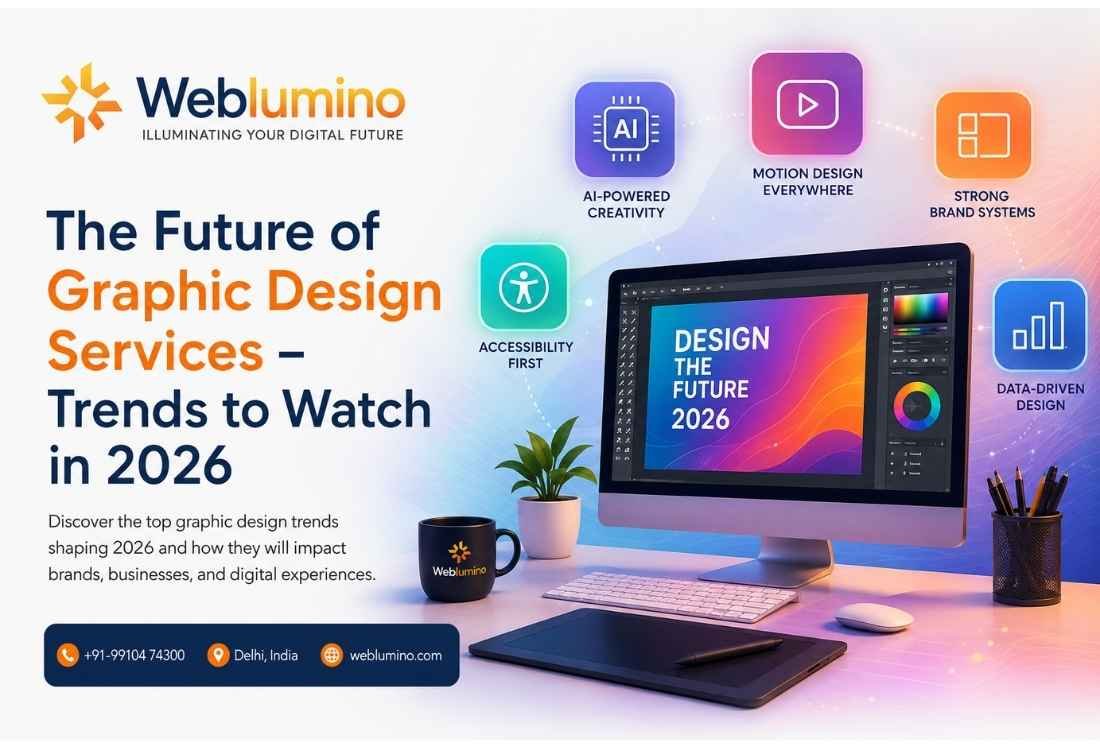
In this rapidly evolving digital world, graphic design still holds a big part in how companies communicate with the market and earn trust with customers. As technology keeps moving forward, and consumer expectations do too, graphic design services are shifting faster than they used to, like almost every quarter. Businesses that actually adapt to these emerging trends can gain a strong edge, bringing in more audiences and building brand moments people remember.
At Weblumino LLP , Delhi, India we keep an eye on what’s happening in the industry to make sure businesses don’t fall behind the competition. And as we move deeper into 2026, several interesting trends are changing the design landscape , and sort of re-writing what professional graphic designers do day to day.
How Design Innovation Is Transforming Business Communication
Graphic design isn’t just about making logos, brochures, or social media posts anymore. Today most companies need an entire visual ecosystem that stays consistent across websites, mobile apps advertising campaigns , and all kinds of digital platforms.
What’s next in design seems less like “produce an image” and more like crafting experiences. People want smooth interactions with brands, not random visuals, and design becomes the link that ties businesses to their audience in a kind of natural way.
Also designers are working much closer with marketers, software developers, content creators, and business strategists. The idea is to make sure visual communication fits the bigger objectives, not only looks nice in isolation.
Five Major Graphic Design Movements Defining 2026
1. Artificial Intelligence Enhances Creative Workflows
Artificial intelligence is turning out to be a quite useful companion in the graphic design field. It is helping designers, but in a way that feels kind of subtle, like AI is assisting quietly with repetitive work, and letting people finish tasks more quickly and with less friction, instead of fully replacing imagination.
AI based systems can come up with design directions, suggest a composition or grid, subtract backgrounds, improve visuals, and streamline the usual editing routines. So designers get more time for higher level thinking, like narrative building and originality.
In the end, companies can ship projects sooner, yet still keep polished creative outputs. And designers in the human sense are still needed, because they offer emotional signals, deeper brand comprehension, and those taste calls that tech tools do not really match, not even close.
The most successful graphic designers in 2026 will likely be the ones who learn how to blend AI ability with human creativity , and then push it toward truly standout results, not just acceptable ones.
2. Dynamic Motion Graphics Become Essential
Static visuals are slowly being nudged aside by animated and interactive content. People spend more time watching videos, engaging with digital advertisements, and browsing social media platforms where movement catches attention, and then keeps it.
Motion graphics are being used across:
- Social media campaigns
- Website interfaces
- Product demonstrations
- Brand storytelling videos
- Digital advertising
- User onboarding experiences
Animation helps communicate information quickly and effectively while creating memorable experiences for viewers.
As internet speeds continue to improve and video consumption rises globally, businesses are investing heavily in motion design to strengthen audience engagement and improve conversion rates.
3. Comprehensive Brand Systems Replace Individual Designs
In the last few years, a lot of businesses spent time on crafting separate design assets. But now, organizations are moving toward full brand systems, which kind of keeps everything visually consistent across all customer touchpoints, not just one or two areas.
A brand system includes:
- Logo variations
- Typography guidelines
- Color palettes
- Design components
- Social media templates
- Website elements
- Marketing materials
When it’s done this way, it’s easier to keep a professional image, and content creation feels more streamlined.
Also, companies that operate on multiple digital platforms need scalable design systems, so it can expand as the business grows. Because of that, graphic designers are often becoming brand architects, developing visual frameworks instead of isolated design pieces, even if they still “design” day to day.
4. User Accessibility Drives Design Decisions
Accessibility is now basically one of the main priorities for most modern companies. Designers are putting together experiences that should be simple enough to understand and use, for people with varying abilities, different devices, and even distinct ways of browsing.
Key accessibility practices include:
- Improved color contrast
- Readable typography
- Mobile-friendly layouts
- Clear navigation systems
- Alternative text for images
- Inclusive visual communication
Companies that take accessibility seriously don’t just reach a wider audience either. They also tend to boost the entire user experience overall.
Also, search engines are increasingly leaning toward accessible websites, so inclusive design matters a lot for digital marketing results. In 2026 accessibility isn’t optional anymore; it is a core requirement for effective graphic design.
5. Analytics-Guided Creative Decisions
Data is getting to be a big influence on design strategy. Rather than leaning only on assumptions, companies now use analytics to figure out how people interact with visual content, in a more grounded way.
Design teams evaluate:
- Click-through rates
- User engagement
- Conversion metrics
- Scroll behavior
- Heatmap analysis
- Customer feedback
With these signals in mind, designers can craft visuals that actually perform better and also create results you can measure for the business.
Data driven design doesn’t really wipe out creativity. It kinda blends imaginative thinking with evidence based decision making, so the overall outcomes come out stronger.
More organizations are also looking for graphic design services that offer both visual appeal and measurable performance upgrades.
The Evolving Responsibilities of Graphic Designers
The role of graphic designers is changing significantly in 2026. Designers are no longer viewed solely as visual creators. They are becoming strategic partners who contribute directly to business growth.
Modern graphic designers are expected to understand:
- Branding principles
- User experience design
- Marketing psychology
- Digital advertising
- Content strategy
- Artificial intelligence tools
- Data interpretation
Businesses want designers who can solve communication challenges, improve customer experiences, and support revenue generation.
As a result, professional designers are expanding their skill sets beyond traditional graphic design techniques.
Successful designers combine creativity, technology, and strategic thinking to deliver comprehensive solutions that help brands stand out in crowded markets.
Emerging Technologies Influencing Design Services
A few technologies are set to keep reshaping graphic design services into 2026 and beyond, in ways that feel kind of faster than people expect.
Augmented Reality Experiences
More brands are leaning on augmented reality for immersive customer moments. Graphic designers also end up involved, not just with art direction but with the visual elements that actually show up inside AR apps and marketing campaigns.
Personalized Visual Content
People are expecting more than a generic look. Companies are working with customer data to build tailored visual content for distinct audience segments , almost like a quiet, continuous customization.
Three-Dimensional Design
3D graphics are still climbing in popularity across websites, ad campaigns, and product presentations. With newer rendering technologies, high-quality 3D visuals are becoming more reachable, and yes more affordable too.
Interactive Digital Experiences
Users are increasingly wanting interaction, instead of simply watching. Designers are crafting interfaces that invite participation , and that kind of boosts customer engagement overall .
Why Businesses Need Future-Ready Graphic Design Services
Companies that invest in modern graphic design gain several competitive advantages:
- Stronger brand recognition
- Improved customer engagement
- Higher conversion rates
- Better user experiences
- Increased marketing effectiveness
- Greater customer trust
As competition keeps getting, well, more intense across industries , professional design ends up being a kind of real differentiator.
Organizations that go with the latest design trends can say things more clearly, pull in better qualified customers and honestly build a stronger market standing .
When they team up with seasoned graphic design specialists, the business can remain in sync with current industry developments while still keeping a consistent, and professional, brand person.
Common Questions About Graphic Design Trends
Is AI replacing graphic designers in 2026?
No. AI assists designers by automating repetitive tasks, but human creativity, strategic thinking, and emotional understanding remain essential components of effective graphic design.
Why is motion design becoming more important?
Motion graphics capture attention more effectively than static visuals and help businesses communicate complex information in engaging ways.
What skills should graphic designers learn in 2026?
Designers should focus on AI tools, branding, motion graphics, user experience design, accessibility standards, and data-driven decision-making.
How does accessibility improve graphic design?
Accessible design ensures content can be used by a wider audience while improving usability, customer satisfaction, and search engine performance.
Why are brand systems important?
Brand systems create consistency across all marketing channels, helping businesses build stronger recognition and trust with their audience.
Connect With Weblumino LLP
As graphic design continues evolving, businesses need creative partners who understand both current trends and future opportunities.
Weblumino LLP helps brands develop modern visual identities, impactful marketing materials, and innovative digital experiences that drive business growth. Our team stays updated with the latest graphic design trends to ensure clients receive forward-thinking solutions that deliver measurable results.
Company Name: Weblumino LLP
Location: Delhi, India
Contact Number: +91-99104 74300
Whether you need branding, digital design, marketing creatives, or complete visual communication strategies, our experts are ready to help your business succeed in the design-driven future.