

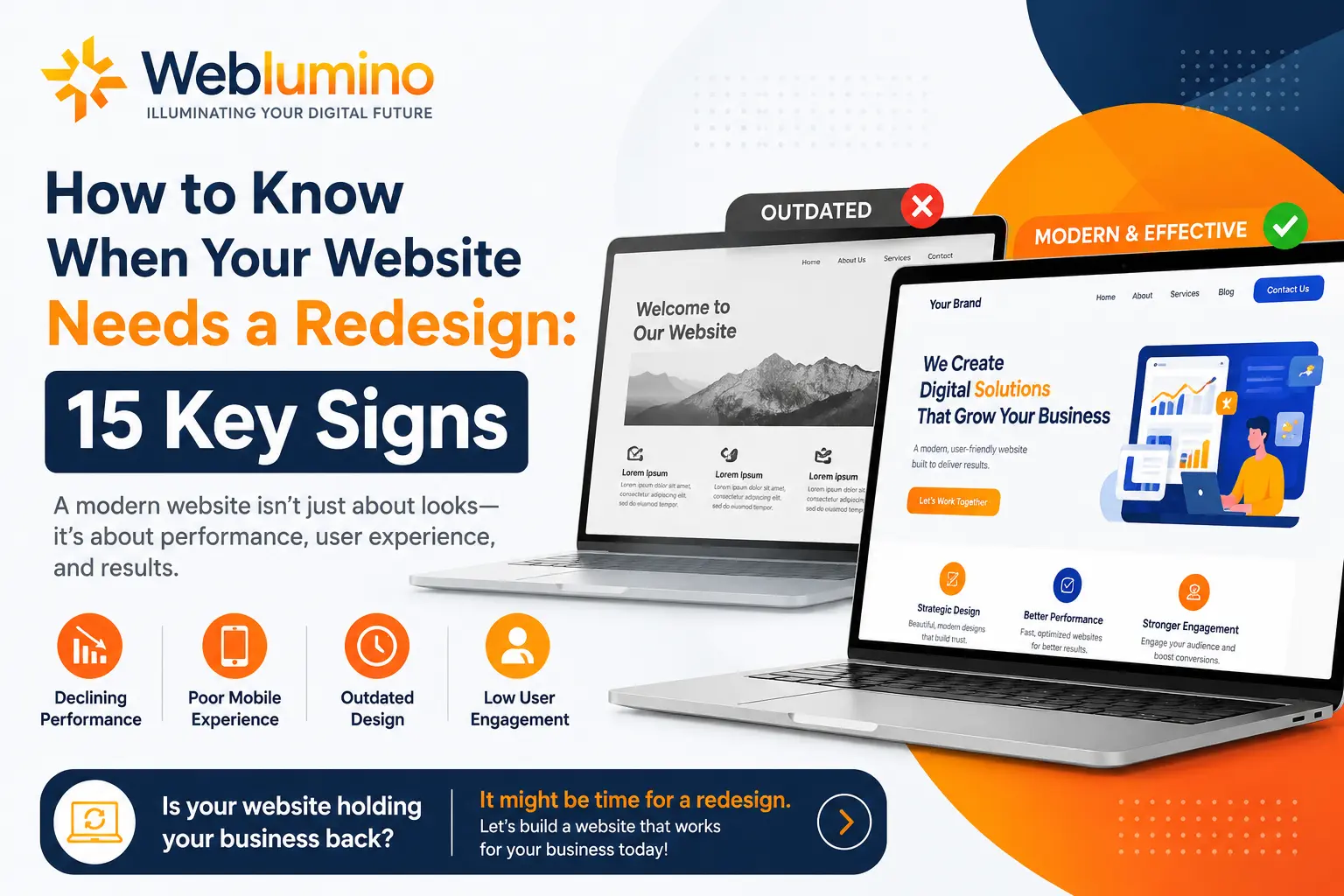
Your website is your most hardworking salesperson; it’s live 24/7, fielding inquiries, building trust, and converting visitors into customers. But what happens when it stops doing its job? Most business owners don’t realise their website needs a redesign until traffic drops off a cliff or a prospect mentions the site looks “a bit old.”
Fortunately, your site will tell you if something is amiss. We have put together 15 telltale signs that a redesign is in order and why you should not overlook them.
1. Your Website Loads Slowly
You can no longer put page speed down to user experience alone; it is a ranking factor. Google has made Core Web Vitals part of the search algorithm, so a site that is slow to load will be penalised by the engines and by users with little patience alike. Let your Largest Contentful Paint (LCP) run over 2.5 seconds, and you will see rankings and revenue slip away.
Do yourself a favour and put your site through a free audit on Google PageSpeed Insights. Should you find your mobile score is under 70, there is no choice but to do a redesign with page speed optimisation at the top of the list.
2. It Looks Outdated Compared to Competitors
You can count on design trends to change course every 3 or 5 years. Take a site put together in 2018 that has been left as is; it will look positively old-fashioned when you put it side by side with what your competitors are doing. Things like flat design and micro-animations, clean whitespace and a mobile-first approach are no longer considered premium add-ons but the bare minimum.
And first impressions are formed in 50 milliseconds. Should your site give off the impression of being stuck in another era, people will be quick to wonder if your products and services are any more current.
3. It Doesn’t Perform Well on Mobile
You can’t put a number on it, but the fact is that more than 60 per cent of web traffic these days is mobile. And if your site doesn’t have the kind of responsiveness to accommodate any screen size, you are putting off most of your visitors before they have a chance to read anything.
Then there is the matter of Google. A subpar mobile experience tells them your site is not user-friendly, and your SEO rankings will suffer for it. For any site that predates responsive design as the norm, that in itself should be a motivation to do an overhaul.
4. Your Bounce Rate Is High, and Conversions Are Low
There is something amiss if people come to your site and are gone in a flash. It could be the navigation is hard to follow, or the content hierarchy is off, maybe even a design that doesn’t inspire confidence. Slow load times will do it too. In any case, when you have a high bounce rate and can’t seem to generate leads, you have all the proof you need that your site is at odds with your business objectives.
5. Your Core Web Vitals Are Failing
Then there is the matter of what Google is looking for. Aside from page speed, they track three Core Web Vitals: LCP for loading, INP for interactivity and CLS for visual stability. You can count on poor marks in those areas to hurt both your user experience and how well you show up in search results.
And should your site be running on an old CMS full of legacy code or a bloated theme, don’t expect to put those numbers right without some kind of structural overhaul.
6. Your Branding Has Changed
Having a rebrand but not updating your website is like getting a new logo on business cards and never printing them. Inconsistent branding colours, fonts, tone of voice or messaging between your own site and your social channels erodes trust and makes your business look like a disorganised mess.
For most of you, if you’ve done a brand identity update in the last year or two, your website better match it.
7. The Content Is Outdated or Missing Key Information
Outdated content will be an SEO deathtrap. Search engines will see your site as being low priority if they check on your services page that is still offering something you stopped doing in 2021, or if your blog posts have not been updated in two years. Even worse, outdated pricing, members of your team who no longer work for you and product information that is missing are a sure-fire way to lose prospective clients.
A redesign offers you the opportunity to audit, refresh and relaunch your content for both users and search engines.
8. Navigation Is Confusing
Statistics show that if users cannot find what they seek within the second click, they lose them. If we move even further down the conversion funnel, there are obvious no-gos like a poor navigation structure, too many items in the menu, no logical hierarchy, and the absence of CTAs, which affect time on site as well as conversion rates.
Good UX Design is taking your visitors from landing to action naturally. If what your structure focuses on is how your team thinks about the site more than how customers browse, a redesign will do it for you.
9. You’re Missing Key Features for Lead Generation
Small business websites today should offer that live chat functionality, a contact form, appointment booking, newsletter sign-ups and conversion paths. If your site does not include these tools, or they exist but are merely glued together with poorly integrated third-party plugins, then you are missing out on qualified leads.
A professional website redesign integrates these features natively, creating a smoother experience for visitors and better data capture for your Online Marketing team.
10. Your CMS Is Difficult to Manage
For example, if making even minor changes to your own website requires you to call a developer each time, your CMS is the bottleneck. Content management systems today power non-technical staff to publish a blog post, update service pages, and add team members without touching a line of code.
Hard-to-prepare content leads to long data refresh intervals, which itself tells Google that your site is not active, as relevant, etc.
11. Your Site Isn’t Generating Organic Traffic
When the issue is that you do not see your core services in search results, these factors indicate your website has a Website SEO problem. Maybe it is bad on-page optimisation, missing metadata, too slow load times, thin content, or even a site architecture that search engines cannot crawl properly.
A redesign based on SEO-first principles; proper use of heading structure, schema markup, optimised page speed and clean URL architecture gives you a fighting chance with organic search.
12. It Doesn’t Reflect Your Current Business
Businesses evolve. New Services, New Markets, New Target Sets. Your website should be an accurate reflection of who you are today (not who you were 3 years ago) because if it isn’t, it is misrepresenting your brand to every single person that lands on your site.
Your website should be a real-time reflection of your current offer, position and value, not a digital museum piece.
13. Your Security Is Outdated
Browsers will warn you, saying “Not Secure” next to an unsecured website (still on the HTTP system rather than HTTPS), which is enough for people to leave immediately. This, however, is just a piece of the puzzle regarding security. Old CMS versions, unpatched extensions and old code are not theoretical vulnerabilities; they put your business, your clients’ data at an actual risk.
A professional redesign is an overhaul of your site, including security checks, and enshrining modern standards into every facet of the design.
14. Your Competitors’ Websites Are Significantly Better
Which site builds more trust for a potential customer who visits it and your competitor’s on the same day? Competitive benchmarking is a straightforward yet effective exercise. In fact, if three or more of your top competitors have cleaner, faster, and/or more feature-rich websites than yours does, you are likely losing business before any sales conversation ever starts.
A website is the mainstay of your Marketing Strategy. To fall behind here is to fall behind commercially.
15. Your Analytics Tell a Story of Decline
Take a look at your Google Analytics for the past 12–24-month period. If we are seeing a downward trend in organic sessions, average session duration is on the decline, or our best-performing pages are losing traction, these are not random blips. They’re like signals that tell you your site is becoming irrelevant.
A reevaluation, paired with a content and SEO strategy designed to push the cart away from here, can turn this flow around and create a whole new, sustainable baseline for growth.
How Often Should You Redesign Your Website?
In general, if your company is doing business on the Internet, you should plan to perform a serious redesign of your website every 3–5 years. You should continually be making minor updates so as not to slow the team down, content refreshes, new landing pages, and plugin updates. If several of these signs occur at the same time, then it is worth a full redesign (or if your growth can no longer be supported by the underlying technology).
FAQ: Website Redesign — Tips, Trends & Common Questions
A refresh typically involves updating content, visuals, or individual pages without changing the underlying structure or technology. A full redesign involves rethinking the site architecture, CMS, design system, and often the hosting infrastructure. If performance or conversion issues are structural, a refresh won’t be enough.
Costs vary widely depending on scope, but a professional small business website redesign typically ranges from ₹50,000 to ₹3,00,000+ in India, or $2,000 to $15,000+ internationally. The investment is almost always offset by improved lead generation, better SEO performance, and reduced maintenance overhead.
It can, if done poorly. A well-executed redesign actually improves rankings by fixing technical issues, improving Core Web Vitals, and optimising content structure. Key safeguards include implementing 301 redirects for changed URLs, preserving high-performing content, and submitting an updated sitemap immediately after launch.
Both serve different purposes. Paid ads bring visitors; your website converts them. Putting ad spend into a site that doesn’t convert is pouring water into a leaking bucket. Fix the conversion foundation first, then scale traffic.
In order of impact: mobile responsiveness, page speed and Core Web Vitals, clear conversion pathways (CTAs), SEO-optimised structure, and content that directly addresses your audience’s questions. Everything else is secondary.
A straightforward small business website typically takes 4–8 weeks from kick-off to launch. More complex sites with custom functionality, e-commerce, or large content libraries can take 3–6 months. Rushing this process is one of the most common (and costly) mistakes businesses make.
WordPress powers over 40% of all websites and remains a strong choice for most small businesses when implemented correctly with a lightweight, well-coded theme, minimal plugins, and proper caching and performance setup. The issues most people associate with WordPress are typically the result of poor implementation, not the platform itself. Alternatives like Webflow and Framer are gaining traction for design-forward projects.
Start with your homepage, your primary service or product pages, and your contact page. These drive the most commercial value. From there, consolidate or remove thin content, update your About page to reflect your current team and story, and build a content plan for ongoing blog publishing to support SEO.
Final Word
A website that is not updated to show what your company truly does, loads slowly or drives visitors away instead of keeping them on the site isnism one thing an aesthetic issue, but rather a revenue issue. If you’ve ticked three or more of these boxes, in all probability the cost of doing nothing is a higher price to pay than commissioning a redesign.
At Weblumino LLP, we build websites that are fast, conversion-focused, and built to rank. If you’re ready to turn your site into a genuine business asset, get in touch with our team for a free website audit.