
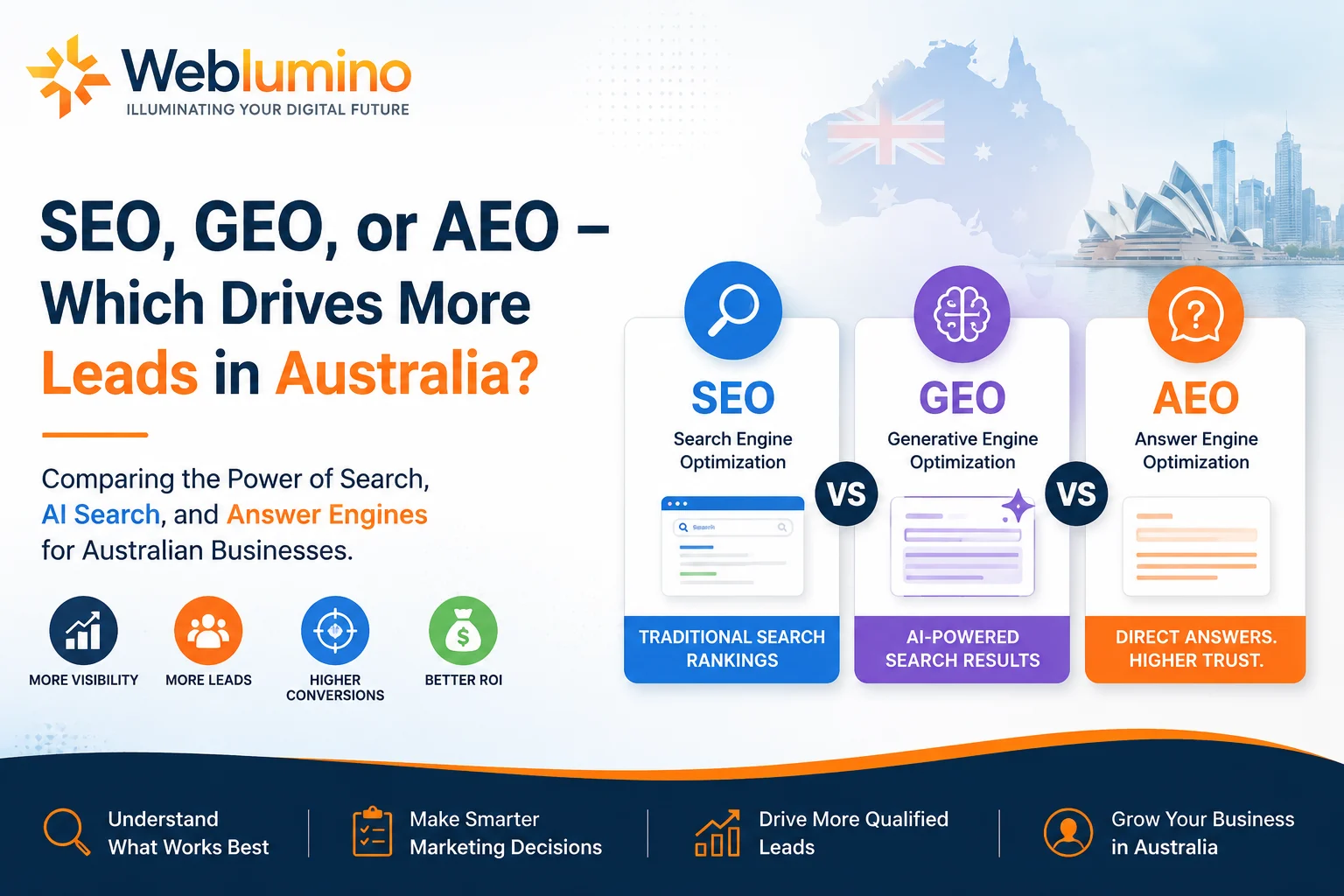
You’ve been in the digital marketing space for a few months, and you’ve probably received a barrage of new terms in your inbox: GEOs, AEOs, AI Overviews, generative search- it’s overwhelming. And the question every business owner in Australia is gently whimpering: what does this REALLY mean for my leads?
This guide cuts through the jargon. We’ll cut through the jargon and clearly define SEO vs GEO vs AEO, explain what each one does for your business in 2026, and give you a guide to where you should be investing your marketing dollar if you’re a local tradie in Brisbane (QLD), SaaS company in Sydney (NSW), or professional services firm in Melbourne (VIC).
What Is SEO (Search Engine Optimisation)?
Search Engine Optimisation is the process of increasing your website’s visibility in organic (free) search results on Google’s search engine. Technical site health, keyword strategy, content quality, links and user experience are covered.
For more than 20 years, SEO has been the backbone of digital marketing in Australia (and it’s not going anywhere). With Google handling more than 8.5 billion searches performed every day all over the world, organic traffic growth is still one of the most cost-effective lead generation strategies attainable for Australian businesses.
What SEO focuses on in 2026:
- On-page optimisation (title tags, headings, structured content)
- Technical SEO (site speed, Core Web Vitals, crawlability)
- Authority building through backlinks and E-E-A-T signals
- Local SEO services for geo-targeted lead generation
- Content that satisfies user intent at each stage of the buyer journey
SEO is still the foundation. Without it, GEO and AEO are largely ineffective because AI search systems pull from pages that already rank and carry authority.
What Is GEO (Generative Engine Optimisation)?
Generating Engine Optimisation is the term for optimising your content to be listed as a referenceable source in AI-generated responses in platforms such as Google A. I Overviews, ChatGPT Search Perplexity and Bing Copilot.
39% of Google searches in Australia now feature AI-generated answers, expected to climb up to 67% by 2026. So if a user types in “best accountant in Perth” or “how to choose a digital marketing agency,” at the top of the page, Google will sometimes display an AI-written summary with no blue links to click on. Your business is either mentioned in that answer, or it’s invisible.
What GEO focuses on in 2026:
- Structured, quotable content that AI systems can extract and attribute
- Schema markup (FAQ, Article, Organisation) to help AI parse your pages
- Topical authority across content clusters, not just isolated blog posts
- Clear, direct answers to questions your customers are actually asking
- Monitoring brand mentions and citations across multiple AI platforms
Generative Engine Optimisation Australia is not a replacement for traditional SEO. It’s an extension of it. The pages that get cited by Google AI Overviews are typically those that already rank well in organic search. Strong SEO creates the platform; GEO strategy ensures you’re the one being quoted.
What Is AEO (Answer Engine Optimisation)?
Answer Engine Optimisation appointments focus your content surfacing as a direct answer by voice search assistants, AI chatbots, featured snippets and conversational search interfaces; these are where users expect only one definite reply with their searches rather than a list of results.
AEO is to optimise for when someone asks their phone, “Who is the best mortgage broker in Melbourne? that requests an answer by talking back. Or when someone asks ChatGPT Identify the digital marketing agencies that specialise in lead generation?” and your brand is the one mentioned.
What AEO focuses on in 2026:
- Conversational, question-and-answer content formats
- Featured snippet optimisation (clear definitions, step-by-step lists, tables)
- Voice search optimisation using natural language and long-tail queries
- FAQ schema to feed AI answer engines structured data
- Building authority as a definitive source in your niche
By mid-2024, nearly 60% of Google searches ended without any click to a website, a trend that has continued into 2026. AEO doesn’t try to fight this shift; it positions your brand to win within it.
SEO vs GEO vs AEO: A Side-by-Side Comparison
| Factor | SEO | GEO | AEO |
| Primary Goal | Rank in organic search results | Get cited in AI-generated content | Appear as a direct answer |
| Key Platforms | Google, Bing | Google AI Overviews, ChatGPT, Perplexity | Voice search, featured snippets, AI chatbots |
| Content Format | Keyword-optimised articles & pages | Structured, quotable, authoritative content | Conversational Q&A, definitions, lists |
| Lead Generation | High (click-through traffic) | Medium-High (brand citation & trust) | Medium (zero-click but brand visibility) |
| Time to Results | 3–6 months | 2–4 months (for cited pages) | 1–3 months (for featured snippets) |
| Best For | Long-term organic traffic growth | AI-era brand authority | Voice search & direct-answer queries |
| Foundation Required | Core technical & content-based | Strong SEO base | Strong SEO + structured content |
Which One Delivers More Leads for Australian Businesses?
The honest answer: none of them alone. In 2026, the Australian businesses generating the most leads from search are running all three in an integrated strategy.
Here’s how it breaks down by business type:
Local Businesses (Tradies, Retail, Hospitality, Healthcare)
Priority: SEO + AEO
For businesses that have a geographic footprint, local SEO services continue to be the highest-ROI strategy. Correctly optimising your Google Business Profile and generating local citations and reviews are the most important factors that directly lead to calls and bookings. Add Layer AEO on top to make sure your business holds up against the voice queries, such as “emergency plumber near me open now”, and you snatch the zero-click mobile search that becomes more popular.
Professional Services (Accountants, Lawyers, Finance, Consultants)
Priority: SEO + GEO
AI search tools are being used by high-intent B2B buyers to narrow down the providers they want to check out before even setting foot on a website. If a Sydney accountant types in the search term “best outsourced CFO services Australia” and your firm has been cited as an authority, that’s a lead qualified with zero clicks. It is compounded lead generation that builds on itself over time, when you add this to competent SEO fundamentals and long-form, authoritative content.
E-commerce and Product-Based Businesses
Priority: SEO + AEO
Product comparison queries and “best of” searches are increasingly answered by AI Overviews. Structured product schema, detailed specification content, and review integration help your products appear in both traditional results and AI-generated summaries.
SaaS and Tech Companies
Priority: GEO + SEO
The lack of AI search visibility is not addressed by traditional SEO agency deliverables; this can be expensive, particularly for SaaS companies where buyers conduct significant pre-sales research before purchase. GEO content (optimised comparison pages, how-to guides with detail and depth, integration documentation) makes your brand the source of truth that AI systems reference when a prospect is researching tools.
The Australian Search Landscape in 2026: What’s Changed
Australian businesses face a specific set of challenges in 2026 that make understanding SEO vs GEO vs AEO especially important:
1. Google AI Overview is now mainstream in Australia. AI-powered search results are no longer a US-only feature; they’re appearing across thousands of Australian search queries daily, particularly for informational and commercial investigation queries.
2. Voice search adoption is accelerating. With smart devices in more Australian homes and workplaces, voice search optimisation is no longer a “nice to have”; it’s a genuine source of local leads, especially in the services sector.
3. Zero-click searches are rising, but intent is stronger. Organic traffic may decline as simple queries get answered on the spot, but the quality of traffic will improve. Users who click through are highly engaged and more likely to convert.
4. AI-powered search marketing requires a new content approach. Keyword-stuffed content doesn’t get cited by AI systems. What gets cited is authoritative, structured, clearly attributed content that directly answers specific questions, the same content that also performs well in traditional SEO.
5. Multi-platform visibility is now essential. Australian businesses need visibility across Google AI Overviews, ChatGPT, Perplexity, and Bing Copilot, not just traditional Google rankings.
How to Build an Integrated SEO + GEO + AEO Strategy in 2026
Rather than treating these as competing approaches, smart Australian businesses are stacking them:
Step 1 — Fix your SEO foundation first. No GEO or AEO strategy works well on a site with technical issues, thin content, or weak authority. Start with a full technical SEO audit, ensure your core pages are properly optimised, and build a consistent content publishing schedule.
Step 2 — Create structured, quotable content. Write content that answers specific questions directly, uses clear headings (H2/H3 format), and contains definitive statements that AI systems can extract and cite. Tables, numbered lists, and definitions are your best format allies.
Step 3 — Implement schema markup strategically. FAQ schema, Article schema, and Organisation schema help both Google and AI systems understand who you are and what you answer. This directly improves AI search results visibility.
Step 4 — Build topical authority, not just individual pages. A single well-optimised page won’t get cited by ChatGPT. A content cluster covering a topic from every angle, including definitions, comparisons, how-to guides, and case studies, builds the topical depth that AI systems recognise as authoritative.
Step 5 — Track AI citations alongside traditional rankings. Your standard Google Search Console data won’t show you how often your brand is cited in AI Overviews or mentioned by Perplexity. Use brand monitoring tools and manually test your key queries across AI platforms to understand your actual AI search visibility.
The Role of Local SEO in the AI Search Era
Local SEO services are still one of the highest converting channels for Australian businesses with a physical presence, but things have changed.
Now, those AI assistants are finally answering location-based queries by leveraging data from Google Business Profile listings, local citations and review signals. AI-driven local packs that are partly powered by blending old-school local SEO with AI answer engine signals are beginning to appear for searches like tens of thousands of “best Italian restaurant in Surry Hills” queries or “digital marketing agency Sydney” strings.
To win locally in 2026:
- Keep your Google Business Profile fully optimised and regularly updated
- Build consistent citations across Australian business directories
- Generate genuine customer reviews that mention your services and location
- Create locally-relevant content that answers questions your community actually asks
- Use the Local Business schema to ensure AI systems can accurately surface your business information
FAQ: SEO vs GEO vs AEO for Australian Businesses
SEO (Search Engine Optimisation) is about ranking your website in Google’s traditional organic results, the ten blue links that appear when someone searches a keyword. AEO (Answer Engine Optimisation) is about becoming the direct, definitive answer that an AI assistant, voice search tool, or featured snippet delivers when someone asks a specific question. The key difference in 2026 is intent and format. SEO drives click-through traffic to your site; AEO wins the zero-click moment where no click happens at all, but your brand still gets mentioned, cited, or spoken aloud. In practice, AEO builds on SEO: you need strong authority and well-structured content to win both.
Several data points define the Australian and global search landscape in 2026. Around 39% of Australian Google searches now show AI-generated answers at the top of the page, up from virtually zero in 2023. Nearly 60% of Google searches end without a click to any website a trend driven by AI Overviews, featured snippets, and knowledge panels. Google still processes over 8.5 billion searches per day globally, and organic search remains the largest single driver of website traffic across industries. For Australian businesses specifically, local voice search queries have grown significantly year-on-year, with mobile users increasingly asking conversational questions rather than typing short keywords. These statistics don’t signal the death of SEO; they signal its transformation.
SEO targets Google’s traditional ranking algorithm to earn positions in organic search results. GEO Generative Engine Optimisation targets the AI systems (Google AI Overviews, ChatGPT Search, Perplexity, Bing Copilot) that generate summarised answers rather than listing pages for users to click through. In 2026, the difference matters because a business can rank #1 on Google and still be completely invisible in an AI-generated answer if its content isn’t structured for citation. GEO requires clearly quotable statements, strong topical authority, schema markup, and an emphasis on being the source AI systems trust, not just the page Google ranks. The good news for Australian businesses: the SEO fundamentals that build rankings (authority, quality content, technical health) also build GEO visibility. They’re not opposites; GEO is SEO’s next evolution.
Yes, but it will look very different. By 2031, SEO will likely be less about ranking in a list of ten links and more about being present across every surface where people discover information: AI-generated answers, voice assistants, social search, visual search, and whatever new interfaces emerge between now and then. The core principles that create authoritative, useful, well-structured content that genuinely serves user intent will remain constant. What changes is the technical execution: more schema markup, more conversational content formats, more multi-platform visibility tracking. Businesses that treat SEO as an evolving discipline rather than a fixed checklist will still be generating leads from search in 2031. Those who stopped investing when AI search emerged will find themselves invisible on every surface.
Evolving clearly and decisively. The “SEO is dead” narrative resurfaces every few years (it was said when mobile search rose, when social media grew, when voice search launched), and it’s been wrong every time. What has changed in 2026 is that the shape of search visibility is more complex. Earning organic traffic now means winning in traditional results, AI Overviews, featured snippets, and voice search simultaneously. Australian businesses that only optimise for blue-link rankings are leaving significant visibility on the table. But the underlying work building a trustworthy, authoritative, well-structured online presence is more valuable in 2026 than it has ever been, precisely because AI systems are selective about which sources they cite.
For Australian businesses, yes, particularly those in professional services, local trades, and any industry where customers ask specific questions before making a buying decision. AEO positions your business to be the answer when a potential client asks their voice assistant for a recommendation, queries ChatGPT for a local provider, or triggers a featured snippet in Google. The opportunity is significant because most Australian businesses haven’t yet optimised for AEO competition. The direct-answer real estate is much lower than for traditional keyword rankings. Businesses that invest in FAQ content, structured data, and conversational content formats now are building a visibility advantage that will compound over the next two to three years as AI-powered search marketing becomes the norm rather than the exception.
This framing has it backwards. GEO is an extension of SEO, not a replacement for it, and neither is replacing the other. In 2026, traditional SEO (ranking in organic results) and GEO (being cited in AI-generated answers) work together as complementary layers of the same search visibility strategy. Pages that don’t rank well in traditional SEO are rarely cited by AI systems. Strong SEO authority is the foundation on which GEO performance is built. What has changed is that strong SEO alone is no longer sufficient; businesses also need to structure their content specifically for AI citation, implement appropriate schema markup, and track their performance across AI search platforms in addition to Google Search Console. The smart move for Australian businesses in 2026 is to run both simultaneously.
No, and any agency telling you to abandon SEO for GEO is giving you poor advice. GEO (Generative Engine Optimisation) addresses a real and growing need: visibility in AI-generated search results. But it builds directly on the authority, technical health, and content quality that SEO establishes. Without a solid SEO base, GEO simply doesn’t work; AI systems preferentially cite pages that already carry ranking authority and demonstrate strong E-E-A-T signals. What GEO does change is the content format and measurement approach: businesses now need to write in ways that are easily extractable and citable by AI, and they need to monitor AI citation rates alongside traditional rankings. Think of GEO not as SEO’s replacement but as its upgrade the same discipline adapted for a search landscape where AI now sits between the user and your website.
Final Thoughts: Which Matters Most for Business Lead Generation Australia?
In 2026, the businesses generating the most leads from search aren’t debating SEO vs GEO vs AEO; they’re running all three as a single, integrated search visibility strategy.
Start with solid SEO fundamentals. Build content that’s structured for AI citation. Optimise for direct answers and voice queries. Track your results across traditional rankings and AI search visibility. And don’t abandon the channels that are already working while chasing what’s new.
At Weblumino LLP, we help Australian businesses build search strategies that work across every surface, from Google’s blue links to AI Overviews to voice search results. If you want to understand where your business currently stands across SEO, GEO, and AEO and what it would take to generate more leads from search in 2026, we’re ready to talk.
Published by Weblumino LLP | Digital Marketing Australia | Specialising in Search Engine Optimisation Australia, Generative Engine Optimisation, and AI Search Marketing for Australian Businesses.