
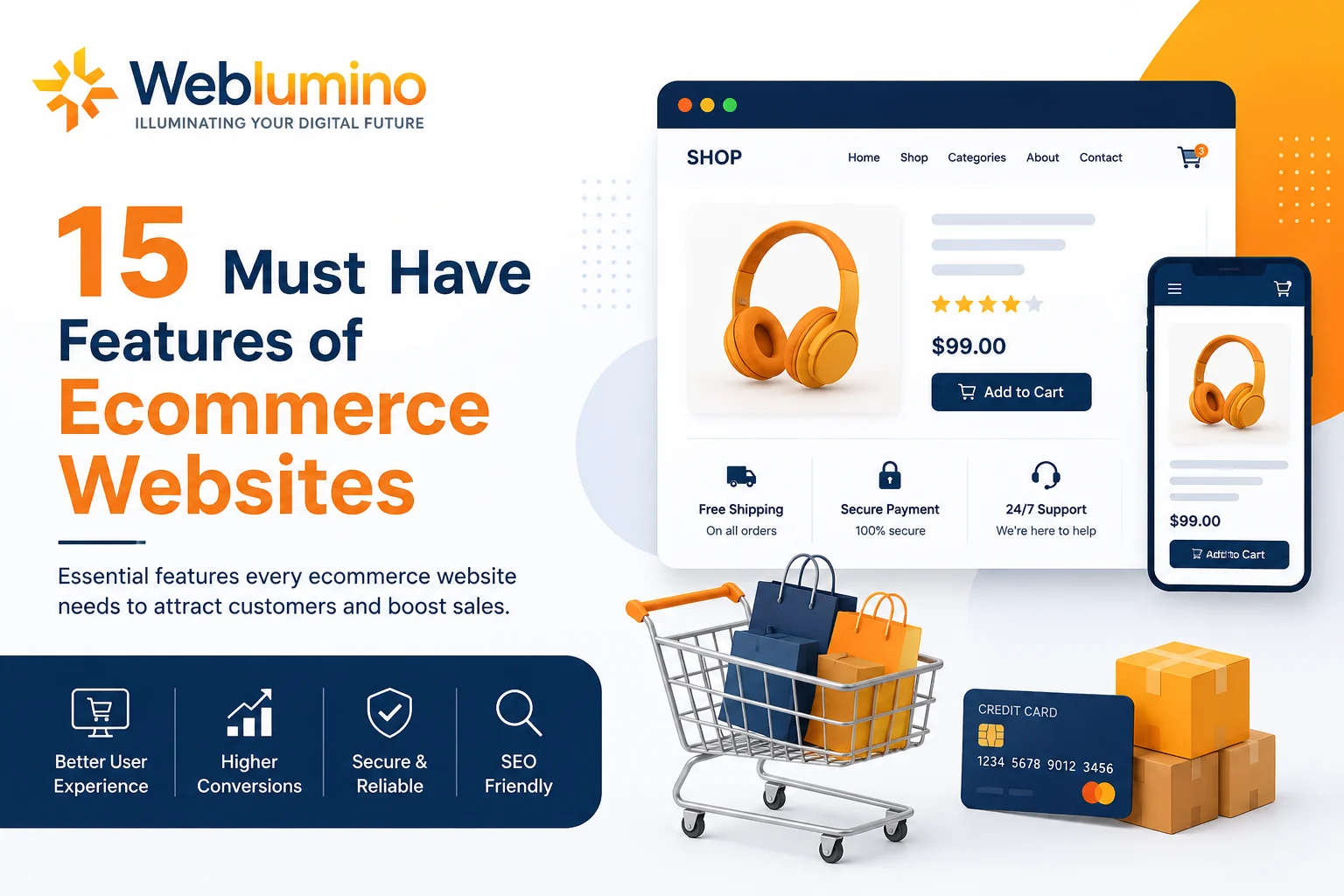
Anyone can put together an e-commerce website. But to build one that turns a casual visitor into a paying customer is another matter entirely.
The numbers don’t lie: with global e-commerce sales on track to top $8 trillion in 2027, there is no shortage of opportunity. Then again, the competition is fierce. What separates a store that is scaling from one that is merely getting by is the features underpinning it. We have put together this guide to walk you through 15 essential elements your e-commerce website should have if you want to drive serious sales, keep people from bouncing, and win your customers’ trust.
1. Mobile-Responsive Design
You can’t put a fine point on it: more than 70 per cent of those shopping online are doing so from their smartphones. So if your e-commerce site is not mobile-optimised, you might as well be ceding revenue to the competition.
That is where a mobile-responsive design comes in. It will ensure that your navigation, images and layout conform to whatever device is being used, be it a phone, tablet or desktop. And it is not merely for looks. Google’s approach to indexing is mobile-first, so the way your site performs on a phone is what will make or break your search rankings.
Key elements of mobile-responsive design: thumb-friendly buttons, auto-scaling product images, simplified menus, and fast-loading mobile pages.
2. Fast Loading Speed
You are losing conversions for every second your website is slow to load. The numbers don’t lie: studies will tell you a one-second lag in page load can put a 7% dent in your conversion rate. Today’s shoppers have no time for an online store that drags its feet.
Then there is the matter of Google, which has made it clear that page speed is a ranking factor. A sluggish site will be pushed down in the rankings and left with less organic traffic while you put off your users. Your goal should be to get load times below 2.5 seconds across the board, whether on desktop or mobile.
Quick wins for speed: compress images with WebP format, use a content delivery network (CDN), enable browser caching, and minimize render-blocking JavaScript.
3. Advanced Product Search
If a shopper is put to the trouble of hunting for something and can’t come by it in a matter of seconds, they will be gone. You need an advanced search function with autocomplete and typo tolerance to make product discovery a non-issue.
Don’t settle for your run-of-the-mill search bar. With AI at work, you can have intelligent tools that anticipate what the user wants and put the right products in front of them, even if their query is a bit vague or has been misspelled. And for those who want to get down to business, faceted filters on price, colour, size, and the like let them hone in on results without any fuss.
Stores with strong internal search functionality see significantly higher average order values because users who search are already in buying mode.
4. User-Friendly Navigation
There is nothing that will drive a visitor away from an e-commerce website quite like confusing navigation. You want your structure to be as logical and intuitive as possible so the path from browsing to a purchase is effortless for the shopper.
To that end, you should follow some tried and true best practices: put a search bar where it can be seen in the header, have well-defined categories, use breadcrumb trails to keep users oriented and employ a tidy mega menu if you are dealing with a sizeable catalogue.
Think of your navigation as a physical store layout; products should be where customers expect them to find them.
5. High-Quality Product Images
You can’t have an online customer put their hands on your wares or try them out. Good product photography is what makes up for that. Put in the effort to show your items from every angle, with 360-degree views and zoom capability, or use lifestyle shots to give the buyer some confidence.
If you can, include a brief video or an AR feature so they can see how it would look in their own home. The numbers don’t lie: studies will tell you that when you have several top-notch images, you’ll see a much better conversion rate than with a single photo or one that isn’t very clear.
Technical note: optimise all images for web using compressed formats (WebP) with descriptive alt text for both SEO and accessibility.
6. Detailed Product Descriptions
You could say a good product description is as much about selling as it is about describing. The copy on your product pages has to do its job and put the shopper’s main question to rest: “Why should I be buying this?”
To be effective, a description will put the emphasis on benefits rather than mere features, allay any objections the customer might have and lay out the technical details for those who want them. And do it in a way that sounds natural while still making use of your keywords.
There is no point in using the boilerplate you get from the manufacturer. Make your copy original and focused on what the product does for the buyer. You will see better conversion rates, and your SEO will thank you for the kind of content search engines like to reward.
7. Customer Reviews and Ratings
There is no more potent conversion tool for an e-commerce website than social proof. You will find that in excess of 90% of your customers will have read the reviews before they commit to a purchase. In fact, having reviews on hand, even if they are mixed, engenders a good deal more trust than a product with nothing to say.
Make sure your star ratings stand out on the listing pages and put room for in-depth written commentary on the product page itself. Then there are the little things that lend credibility: verified purchase badges, photos from reviewers and a Q&A section.
Don’t fear negative reviews. A mix of ratings appears authentic; a product with only 5-star reviews can actually trigger suspicion.
8. Secure Payment Gateway
You can’t have e-commerce without trust. A customer has to be sure his or her financial information is in safe hands before parting with card details.
That is where a good payment gateway comes in. It will put SSL/TLS protocols to work to encrypt the data and make no secret of its security with padlock icons, “Secured by” badges and PCI-DSS compliance markers for all to see at checkout.
We recommend you go with an established name like Razorpay, Stripe, PayU or CCAvenue in the Indian market. They are the ones to handle the nitty-gritty of fraud detection and chargebacks, as well as keeping up with security patches, so you don’t have to.
9. Multiple Payment Options
There is a quiet way to lose conversions, and that is by being too restrictive with your payment methods. You have to remember that customers have their own preferences; if you do not give them what they want, they will take their business to someone who will.
An e-commerce website needs to be accommodating. Make sure you have credit and debit cards on the table as well as UPI, net banking and digital wallets such as Google Pay, PhonePe or Paytm. Don’t forget EMI and BNPL services from the likes of Simpl or LazyPay.
This is particularly true in India, where UPI is now king for online transactions. By having a varied array of options, you take away any last obstacle standing between a customer’s intent to buy and the actual purchase.
10. Easy Checkout Process
Cart abandonment rates average around 70% globally, and a complicated checkout process is one of the leading causes. Every additional step, form field, or redirect during checkout increases the likelihood of a user dropping off.
Streamline your checkout by offering guest checkout (don’t force account creation), enabling auto-fill for shipping details, displaying a progress indicator, and minimizing the number of pages or steps required.
A single-page or two-step checkout dramatically reduces friction. Also, ensure your checkout is mobile-optimized. Nothing kills a mobile sale faster than a clunky checkout form.
11. Wishlist Functionality
Not every visitor is ready to buy immediately, but that doesn’t mean they’re not interested. Wishlist functionality lets users save products they love and return when they’re ready to purchase.
Wishlists serve a dual purpose: they reduce decision fatigue for indecisive shoppers and give you powerful data about which products generate the most desire (even when they’re not immediately purchased).
Pair wishlists with email reminders (“Items in your wishlist are selling fast”) to re-engage potential buyers and recover otherwise lost sales.
12. Live Chat Support
Real-time support removes the final friction points in the buying journey. When a shopper has a question about sizing, shipping timelines, or return policies, a live chat widget gives them an instant answer, keeping them on the path to purchase.
AI-powered chatbots have made live chat scalable even for small businesses. They can handle FAQs around the clock and escalate complex queries to human agents. Studies show that websites with live chat see measurably higher conversion rates compared to those relying solely on email or phone support.
13. Inventory Management Display
Nothing damages customer trust faster than completing an order only to receive an out-of-stock notification. Real-time inventory management display keeps shoppers informed at every stage.
Show live stock counts (“Only 3 left!”), display “Out of Stock” labels clearly on product pages, and offer “Notify Me” options for sold-out items. Low-stock alerts can also create genuine urgency that nudges on-the-fence buyers toward a faster decision.
From an operational standpoint, integrated inventory management prevents overselling, reduces customer complaints, and improves your fulfilment accuracy.
14. Personalized Product Recommendations
AI-driven personalization has transformed e-commerce. Personalized product recommendations based on browsing history, purchase behaviour, and similar customer profiles significantly increase average order value and time on site.
Display recommendations across multiple touchpoints: on product pages (“You may also like”), in the cart (“Complete the look”), on the homepage for returning visitors, and in post-purchase emails (“Shop more like your last order”).
Amazon attributes a significant share of its revenue to its recommendation engine. Personalization isn’t a premium feature anymore, it’s an expectation.
15. SEO-Friendly Structure
An e-commerce website that nobody can find in search results won’t generate sales. An SEO-friendly structure ensures your store is discoverable, crawlable, and rankable.
Core SEO elements include: clean, keyword-rich URLs (e.g., /womens-running-shoes/), optimized title tags and meta descriptions for every product and category page, structured data markup (Schema.org) for rich results, a logical site hierarchy, fast load speeds, and an auto-generated XML sitemap.
Don’t overlook technical SEO: canonical tags to avoid duplicate content issues across product variants, proper 301 redirects for discontinued products, and optimized crawl budgets for large catalogues.
Frequently Asked Questions (FAQs)
An e-commerce website is an online platform that allows businesses to sell products or services directly to customers over the internet. It includes product listings, a shopping cart, payment processing, and order management, essentially a digital storefront that operates 24/7.
The cost varies widely depending on your requirements. A basic e-commerce website built on platforms like Shopify or WooCommerce can start from ₹30,000–₹80,000. A custom-built store with advanced features, integrations, and a unique design can range from ₹1,50,000 to several lakhs. Ongoing costs include hosting, domain, payment gateway fees, and maintenance.
The best platform depends on your business size and goals. Shopify is ideal for quick setup and scalability. WooCommerce (WordPress) offers flexibility and is cost-effective for content-heavy stores. Magento suits large enterprises with complex catalogue needs. For Indian businesses, platforms with native UPI and GST integration offer additional advantages.
Focus on reducing friction at every stage of the customer journey. Improve site speed, simplify your checkout process, add more product images and detailed descriptions, display genuine customer reviews, offer multiple payment options, and use exit-intent popups or abandoned cart email flows to recover lost sales.
Extremely important. In India, over 75% of internet traffic comes from mobile devices, and this number is even higher for shopping categories. A poor mobile experience directly translates to lost revenue. Google also ranks mobile-optimised sites higher in search results, making mobile responsiveness both a UX and SEO priority.
At minimum: an SSL certificate (HTTPS), a PCI-DSS compliant payment gateway, two-factor authentication for admin accounts, regular software updates and security patches, strong password policies, and bot protection to prevent credential stuffing and scraping.
A multi-channel approach works best. Start with SEO to build long-term organic traffic, run targeted Google Shopping and Meta ads for quick visibility, leverage social media marketing and influencer partnerships, build an email list from day one, and consider content marketing (blogs, buying guides) to attract shoppers at the research stage of their journey.
The global average cart abandonment rate is approximately 70%. To reduce it: simplify checkout, offer guest checkout, be upfront about shipping costs early in the journey, send automated abandoned cart emails (a 3-part sequence within 24 hours works well), display trust signals prominently at checkout, and offer live chat support for last-minute hesitations.
Significantly. Products with reviews convert at 3–4x the rate of products without them. Reviews reduce purchase anxiety, provide social proof, and often contain the exact language potential buyers are searching for, which also boosts SEO. Encourage reviews through post-purchase emails and make leaving a review as frictionless as possible.
LSI (Latent Semantic Indexing) keywords are thematically related terms that help search engines understand the full context of your content. For an e-commerce website selling running shoes, LSI keywords might include “athletic footwear,” “cushioned sole,” “marathon training gear,” and “breathable sneakers.” Using them naturally throughout your product pages and blog content improves topical depth and search rankings without keyword stuffing.
Final Thoughts
A high-converting e-commerce website isn’t built on aesthetics alone; it’s built on strategy. From fast loading speeds and mobile-responsive design to personalized recommendations and a secure checkout, every feature on this list serves one purpose: making it as easy as possible for the right customer to buy from you.
At Weblumino LLP, we build e-commerce websites that don’t just look good; they perform. Whether you’re launching a new online store or optimising an existing one, the right combination of features, design, and SEO strategy is what separates a store that survives from one that scales.
Have an e-commerce project in mind? Get in touch with the Weblumino LLP team today.