
SEO has shifted a lot over the last few years. Just dropping keywords in different spots on a page is no longer enough to secure top spots on Google. Modern search systems rely on advanced AI that is trying to grasp what people truly need, not simply align with the exact terms they type in, or the order they type them in, either.
So if a business keeps leaning on old keyword stuffing methods they often get stuck, rankings slow down, and visibility stays low. Meanwhile sites that publish useful content tied to search intent (not only to words), tend to gain steadier traction, and they usually see better conversions too.
Because of that, understanding how search intent connects with keywords has become basically mandatory for any company trying to grow online in 2026. At Weblumino LLP, we create SEO plans that blend smart keyword research with user-first material, so your pages attract the right audience and support durable growth over time.
What Are Keywords in Modern SEO?
Keywords in modern SEO are basically the words, and sometimes short phrases, that people type into search engines when they need info, products , or services. They still matter a lot for SEO, mostly because they help search engines figure out what your content is about, you know in a clearer way.
Examples include:
- SEO company for small business
- Digital marketing agency
- Local SEO services
- Technical SEO audit
- Content marketing strategy
But, honestly modern SEO isn’t about reusing the same keyword, over and over, like a loop. Google’s algorithms now judge whether your page actually answers the user’s intent or query.
Today, successful keyword optimization includes:
- Primary keywords
- Long-tail keywords
- Semantic keywords
- Related search terms
- Natural language variations
- Entity-based optimization
Instead of writing for search engines alone, websites must now write for people while helping search engines understand the complete context.
What Is Search Intent?
Search intent refers to the actual purpose behind a user’s search. It answers the question:
“What does the user really want to accomplish?”
Google’s primary goal is to provide the most helpful result for every search.
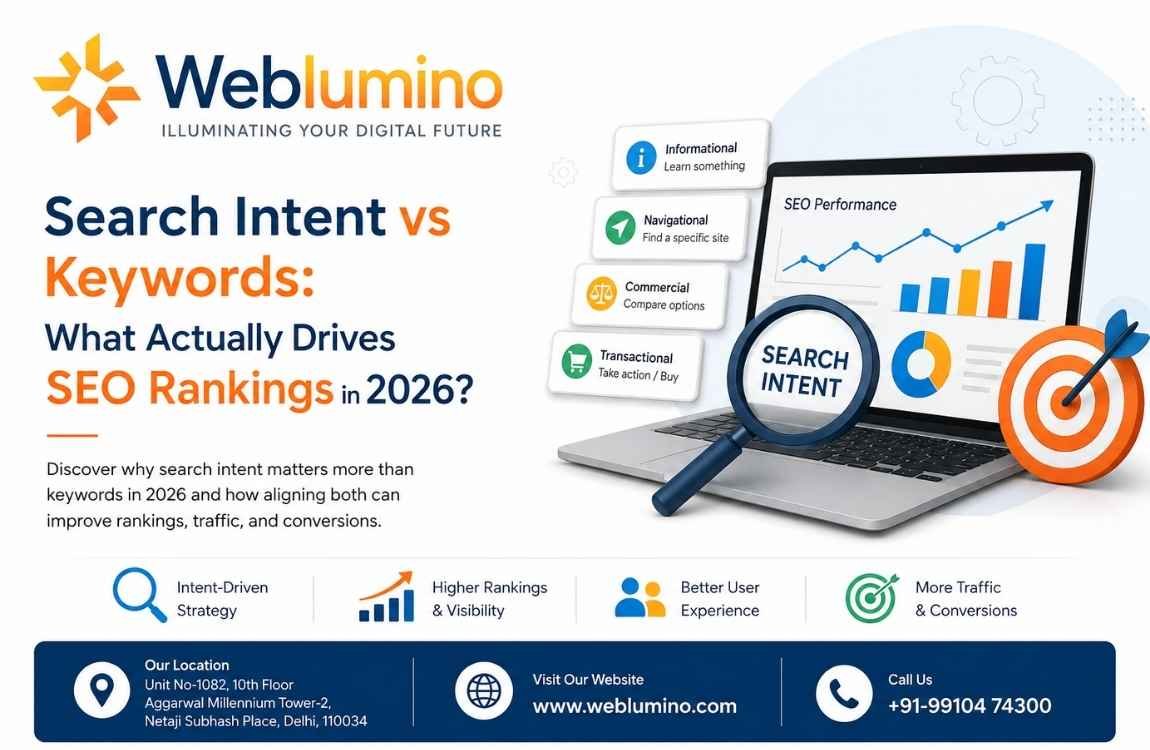
There are four major types of search intent:
Informational Intent
Users want to learn something.
Examples:
- What is SEO?
- How does Google ranking work?
- SEO tips for beginners
Navigational Intent
Users are searching for a specific website or brand.
Examples:
- Weblumino LLP
- Google Search Console
- WordPress login
Commercial Investigation
Users are comparing products or services before making a decision.
Examples:
- Best SEO agency
- SEO packages comparison
- Local SEO vs national SEO
Transactional Intent
Users are ready to take action.
Examples:
- Hire SEO expert
- Buy SEO services
- Request SEO consultation
Understanding these intentions allows businesses to create pages that directly match user expectations.
Search Intent vs Keywords: Understanding the Difference
Although keywords and search intent work together, they are not the same.
| Keywords | Search Intent |
| The words users type | The reason behind those words |
| Focus on search phrases | Focus on user goals |
| Help Google identify topics | Help Google determine the best result |
| Important for optimization | Critical for rankings |
For example:
Keyword:
“SEO company”
Possible intents:
- Learn what an SEO company does
- Compare agencies
- Hire an SEO company immediately
Each intent requires different content.
Why Keywords Alone No Longer Guarantee Rankings
Years ago, websites could rank simply by repeating a keyword several times.
That strategy no longer works.
Google’s AI systems now evaluate:
- Content quality
- User engagement
- Experience
- Expertise
- Authority
- Trustworthiness
- Search intent satisfaction
- Topical relevance
Keyword stuffing often results in poor readability and weak user experience.
Instead, Google rewards pages that genuinely answer questions, solve problems, and provide valuable insights.
This is why businesses must move beyond traditional keyword optimization.
How Google Understands Search Intent in 2026
Google has become significantly better at interpreting human language.
Its AI-powered systems analyze:
User Behavior
Google studies how users interact with search results.
Examples include:
- Click-through rate
- Time on page
- Bounce rate
- Return searches
Context
Google understands relationships between words instead of treating each keyword separately.
For example:
“Best SEO agency near me”
Google recognizes:
- Local intent
- Service intent
- Comparison intent
Semantic Search
Modern search engines understand:
- Synonyms
- Related concepts
- Industry terminology
- User context
AI-Powered Search
Generative AI helps Google understand complete conversations instead of isolated keywords.
As a result, websites that answer real questions naturally perform much better.
Why Search Intent and Keywords work pretty well together
Keywords are what help Google get the topic of your page straight.
Search intent is how Google judges if your page is actually the right fit, like answering the real question.
The best SEO approach, honestly mixes both together, so they reinforce each other rather than kind of argue.
For example:
Primary keyword:
SEO company for small business
Intent:
A small business owner wants affordable SEO services that generate measurable results.
The content should therefore explain:
- Services
- Benefits
- Pricing guidance
- Success stories
- Contact information
- Consultation options
Matching both keyword relevance and user intent increases rankings while improving conversion rates.
How to Align Your Content with Search Intent
Creating intent-driven content requires understanding your audience.
Here are several effective strategies.
Research User Questions
Use search suggestions, FAQs, forums, and customer inquiries to identify common problems.
Study Search Results
Analyze the first page of Google.
Look for:
- Content length
- Search intent
- Featured snippets
- FAQs
- Videos
- Images
Google already indicates what users expect.
Write Comprehensive Content
Instead of producing thin articles, create pages that answer every important question surrounding a topic.
Comprehensive content builds topical authority.
Use Natural Language
Avoid forcing keywords into every sentence.
Write naturally while incorporating related phrases and semantic terms.
Improve User Experience
Content should be:
- Easy to scan
- Mobile-friendly
- Fast-loading
- Well-structured
- Helpful
Google increasingly rewards positive user experiences.
Best Practices for SEO Success in 2026
SEO success now depends on combining technical excellence with valuable content.
Best practices include:
- Focus on user-first content
- Target search intent before keywords
- Build topical authority
- Optimize Core Web Vitals
- Improve page speed
- Create helpful FAQs
- Use structured data
- Publish original insights
- Update older content regularly
- Build high-quality backlinks
- Optimize for AI-generated search experiences
- Strengthen internal linking
- Monitor user engagement metrics
Businesses that follow these principles consistently outperform competitors relying on outdated SEO tactics.
How Weblumino LLP Builds SEO Strategies That Rank and Convert
At Weblumino LLP, we believe successful SEO is about much more than rankings—it’s about generating real business growth.
Our team develops customized SEO campaigns built around both keyword intelligence and search intent.
Our services include:
- Comprehensive SEO audits
- Search intent research
- Advanced keyword strategy
- Technical SEO optimization
- Local SEO
- Content marketing
- On-page optimization
- High-quality link building
- AI-ready SEO strategies
- Performance tracking and reporting
Every strategy is designed to increase visibility, attract qualified visitors, and convert traffic into customers.
Whether you’re a startup, local business, or enterprise, we create scalable SEO solutions that deliver measurable results.
Company: Weblumino LLP
Contact: +91-99104 74300
Keywords + Search Intent = SEO Success in 2026
So basically, the next wave of SEO will be for businesses that kinda get both keywords and user intent , at the same time.
Keywords are still important, because they basically help search engines understand what your page is about. Search intent is what decides if your content actually answers what people are trying to find.
When those two work together with solid content quality, technical optimization, a smooth user experience, and information that feels credible and authoritative, then you end up with the real foundation for long term SEO wins.
Instead of chasing rankings with tired tactics that don’t really work anymore, try aiming for helpful content that resolves actual problems . This usually leads to stronger positions in search results, plus it builds trust, boosts engagement, and supports lasting business growth.
If you’re ready to lift your organic visibility using an SEO plan made for 2026, Weblumino LLP can help.
Frequently Asked Questions About Search Intent, Keywords & SEO in 2026
1. What is the difference between search intent and keywords?
Keywords are the search terms users enter into Google, while search intent explains the reason behind those searches. Understanding both helps create content that ranks and satisfies user needs.
2. Are keywords still important for SEO in 2026?
Yes. Keywords remain important for helping search engines understand your content, but they should be used naturally alongside intent-focused, high-quality information.
3. Why is search intent important?
Search intent helps ensure your content matches what users expect. When your page fulfills that intent, it is more likely to rank higher and keep visitors engaged.
4. How can I identify search intent?
Review the top-ranking search results, analyze the types of content Google displays, and consider whether users are seeking information, comparisons, navigation, or a purchase.
5. Does AI affect SEO rankings?
Yes. AI-powered search systems evaluate content quality, relevance, context, and user satisfaction, making intent-focused content more important than ever.
6. Can Weblumino LLP help improve my website’s SEO?
Absolutely. Weblumino LLP provides customized SEO services, including keyword research, search intent analysis, technical SEO, content optimization, local SEO, and ongoing performance monitoring to help businesses increase rankings, traffic, and conversions.