
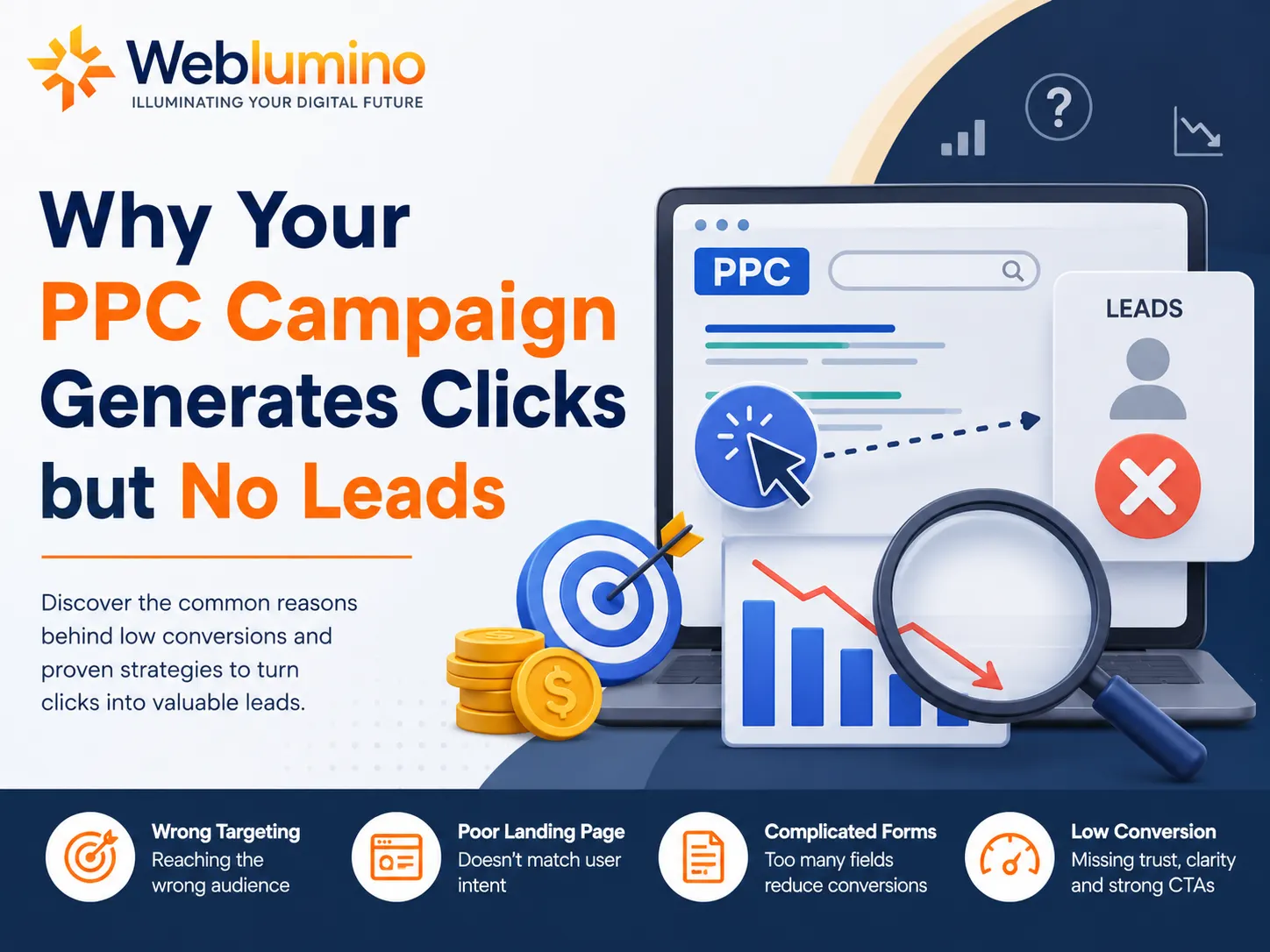
If your PPC campaign is generating clicks but no leads, the problem almost certainly isn’t the platform. It’s the strategy behind it. Clicks are a micro-signal of interest, not intent. Most advertisers confuse the two, and that confusion quietly drains budget month after month. This guide breaks down exactly why your Google Ads are attracting visitors but repelling conversions, and what you can do right now to fix it.
The Real Cost of Clicks That Don’t Convert
Let’s be direct: a click that doesn’t convert isn’t a near-miss. It’s a loss.
According to industry data, the average Cost per Lead (CPL) across industries now exceeds $70, yet a large portion of that spend never turns into an actual inquiry. When you’re paying for every click, every wasted visit has a price tag, and those costs stack up fast.
The worst part? Most businesses don’t know their PPC campaign is broken. The dashboard shows traffic, CTR is decent, and spend looks “normal.” But the pipeline is empty, and the phone isn’t ringing.
This is what an optimized-for-traffic (instead of optimized-for-leads) campaign looks like from the inside.
7 Reasons Your PPC Campaign Gets Clicks but No Leads
1. You’re Targeting the Wrong Search Intent
Not every keyword that looks relevant is relevant. There’s a massive difference between someone searching “what is PPC advertising“ and someone searching “hire PPC agency for lead generation.” The first is a researcher. The second is a buyer.
High-volume, low-intent keywords are one of the most common budget killers in Google Ads. They inflate your click count, damage your Quality Score over time, and rarely produce a form fill or a phone call.
The fix: Pull up your Search Terms Report in Google Ads. Identify every query that triggered your ads in the last 30 days. Flag anything that doesn’t signal buying intent; terms like “how to,” “what is,” “definition,” or “free” are almost always research queries, not purchase queries. Add them as negative keywords immediately. Then double down on high-intent phrases using modifiers like “hire,” “get a quote,” “best agency for,” “near me,” or specific service terms with location.
2. Your Landing Page Doesn’t Continue the Ad’s Promise
Every ad creates an expectation. The moment someone clicks, they’re expecting what the ad promised. If your landing page delivers something different, even slightly, that expectation breaks, and so does your conversion.
This is called a message mismatch, and it’s one of the most overlooked problems in PPC advertising strategy. Generic homepage redirects are the worst offenders. If your ad says “Get a Free PPC Audit for Your Business,” but the landing page talks broadly about digital marketing services, visitors feel misled. They bounce.
The fix: Each ad group should point to a dedicated landing page that mirrors its exact message. Headline, offer, tone, and CTA must match. If you’re running five ad groups, you need five landing pages. Yes, that’s more work, but it’s also how you cut Cost per Lead in half.
3. Your Negative Keyword List Is Minimal or Nonexistent
Running a PPC campaign without negative keywords is like running a store with no door; everyone wanders in, but most of them are never going to buy.
Negative keywords tell Google what searches you don’t want to show up for. Without them, your ad can appear for wildly irrelevant queries, costing you clicks from people who have no interest in what you sell.
Real example: A B2B software company running ads for “project management tool” without negatives could end up paying for clicks from students searching “free project management tool for school assignments.” Every one of those clicks costs money. None will convert.
The fix: Build your negative keyword list before you launch, not after. Start with obvious categories: informational queries, competitor brand names (unless you’re targeting them intentionally), irrelevant industries, and free/DIY modifiers. Review your Search Terms Report weekly and keep adding.
4. Your Landing Page Experience Is Hurting Your Quality Score
You pay Google only for clicks; in fact, it rewards you and punishes you based on how good an experience your ad actually is. Welcome to your Quality Score, a 1-10 score based on 3 factors: expected CTR, ad relevance, and landing page experience, all determined by Google.
The lower your Quality Score, the more you pay per click compared to other advertisers, and the further down on each results page your ads show up. A high Quality Score means you pay less and rank higher. It’s one of the most powerful levers in Google Ads optimisation that most advertisers ignore.
Of all these factors, landing page experience is the hardest to leverage, but it has the biggest impact. As it relates to your home page or landing pages, Google looks at load speed, mobile-friendliness (responsiveness), content relevance to the search query, ease of navigation, and a clear call to action.
The fix: Take your landing page and run it through Google PageSpeed Insights. Mobile scores lower than 70/100 must be improved. Avoid navigational menus that allow users to leave your site. Make your headline specific. Mobile page load time under 3 seconds. One goal per page. One conversion action per visit.
5. Your Offer Isn’t Compelling Enough to Act On
No matter how great your targeting is or how quick and beautiful your landing page, without an offer that gives people a reason to act now rather than later, the campaign will ultimately flop.
Weak offers are vague. It is not an offer to contact us for more expertise. Example: Free 30-minute PPC audit. We show you exactly where your budget leaks. Specificity, clarity, and implied value are the things that make the difference.
This is the core of Conversion Rate Optimisation (CRO) as it applies to PPC. You’re not just designing a page; you’re designing a decision.
The fix: Audit your current offer with one question: “Would I fill out this form for this?” If the answer is hesitation, rewrite it. Give people something of immediate value: a free audit, a custom quote, a downloadable resource, a strategy call. Set a clear expectation of what happens after they submit: “We’ll respond within 24 hours with your personalised report.”
6. Audience Segmentation Is Too Broad
Target everyone; convert nobody. Broad audience settings = wasting a lot of your dollars on people who are not in your ICP either geographically or demographically.
Some examples of segmentation failures include: a local service business that targets the country, a B2B SaaS company that targets all age groups with no income or job-title filter, an agency running the same ad to cold audiences and warm retargeting pools, and we see these types of things happening, so MPC (Cost per Click) skyrockets, CAC (Customer Acquisition Cost) crushes conversion rates.
The fix: Build distinct audience segments based on your actual customer data. Use in-market audiences to reach people actively searching for your service category. Apply demographic filters that match your buyer profile. Separate your cold traffic from your warm traffic (website visitors, video viewers, email list) and run completely different messages to each.
7. Conversion Tracking Is Broken or Misconfigured
This is the silent killer. When your conversion tracking is wrong, everything else is wrong, including the decisions you make to fix it.
Many Google Ads accounts are tracking micro-actions (page scrolls, button hovers, session duration) as full conversions, inflating the numbers and signalling to Google’s algorithm to keep sending the same type of traffic. Others are missing real form fills because the tag isn’t firing on the thank-you page.
Google’s Smart Bidding strategies (Target CPA, Maximise Conversions, Target ROAS) rely 100% on the conversion data you give them. If that data is inaccurate, your bidding strategy optimises for the wrong thing.
The fix: Use Google Tag Assistant to verify every conversion tag is firing correctly. Click through a test form yourself. Confirm the thank-you page triggers your conversion event. Audit which actions are marked as “primary” vs “secondary” conversions in your account. If call tracking is part of your lead generation strategy, make sure it’s connected to the right campaigns and counted as a conversion.
How to Build a PPC Campaign That Actually Generates Leads
Getting from “clicks but no leads” to a campaign that consistently fills your pipeline requires fixing the foundational issues above and adding a few strategic layers.
Build a Proper Conversion Funnel
Most PPC campaigns send everyone to the same page regardless of where they are in the buying journey. A well-structured conversion funnel separates cold awareness traffic from high-intent decision-stage traffic and treats them differently.
Cold traffic (people who don’t know you yet) needs trust-building content and a low-friction CTA. Warm traffic (people who’ve visited before or engaged with your content) needs a direct, specific offer. Design your campaigns to reflect these stages, and your ROI from PPC will improve significantly.
Layer in Remarketing Campaigns
Most users don’t convert on their first visit; industry data consistently shows that 96–98% of first-time visitors leave without taking action. Remarketing campaigns let you re-engage those visitors with tailored messaging.
Someone who visited your pricing page but didn’t convert is a very different target than someone who only landed on your homepage. Build separate remarketing audiences based on the pages visited, and serve them ads that address the specific hesitation they likely had.
Remarketing clicks typically cost 30–60% less than cold traffic clicks and convert at significantly higher rates.
Integrate PPC With Your Broader Digital Marketing Strategy
PPC doesn’t work in isolation. A campaign running without SEO support, without content that builds trust, and without a social presence to reinforce credibility is working at a fraction of its potential.
Organic search rankings establish long-term authority. Content answers objections before the ad click. Social media builds brand familiarity so that when someone sees your ad, they already know your name. When PPC runs alongside a strong digital marketing strategy, cost per lead drops and lead quality improves.
Run Structured A/B Tests
Testing one variable at a time, a headline, a CTA, a form length, and a landing page layout is how you systematically improve campaign performance. The keyword is “structured.” Random changes produce noise. Planned tests with defined success metrics produce insights.
Let each test run long enough to reach statistical significance before concluding. Small percentage improvements in conversion rate compound into large reductions in Cost per Lead over time.
Quick Diagnostic: Is Your PPC Campaign Optimised for Leads?
| Issue | Check | Fix Priority |
| High CTR, low conversions | Landing page mismatch | High |
| High spend, low lead volume | Broad keywords / poor intent | High |
| Low Quality Score | Landing page experience | High |
| Good traffic, high bounce rate | Offer too weak | Medium |
| Rising CPC month over month | Poor audience segmentation | Medium |
| Unreliable conversion data | Broken tracking | Immediate |
| No follow-up on warm visitors | No remarketing setup | Medium |
Real-World Case Example: B2B Agency Cuts CPL by 58%
A mid-sized B2B services company was spending ₹2.5 lakh/month on Google Ads with a healthy click volume but almost no lead form submissions. After auditing the account, the core issues were:
- 67% of the budget is going to broad match keywords with no commercial intent
- All ads pointing to the homepage
- No negative keyword list
- Conversion tracking firing on a “visit duration” metric, not actual form submissions
After fixing keyword intent, creating dedicated landing pages per service, building a 400-word negative keyword list, and correcting conversion tracking:
- Cost per Lead dropped from ₹8,400 to ₹3,500 (58% reduction)
- Lead volume increased by 3.2x on the same monthly budget
- Quality Score improved from an average of 4 to 7 within 6 weeks
The budget didn’t change. The strategy did.
Frequently Asked Questions (FAQ)
The most common reasons are keyword intent mismatch (attracting researchers instead of buyers), a landing page that doesn’t continue the ad’s promise, a weak or vague offer, or broken conversion tracking that misreports what’s actually happening. Usually, it’s a combination of these rather than a single issue.
There’s no fixed number, but a well-managed campaign typically has hundreds of negative keywords, and that list grows over time. New advertisers should start with a minimum of 50–100 before launching, covering informational queries, irrelevant industries, and free/DIY terms. Review the Search Terms Report weekly and add to the list every time an irrelevant query appears.
Across industries, the average Google Ads conversion rate sits between 3–5%. However, well-optimised campaigns in competitive B2B niches often target 5–10%, while some high-intent local service categories can see 15%+. If your conversion rate is below 2%, your landing page or offer needs immediate attention.
Quality Score directly impacts your Cost per Click. A Quality Score of 10 can reduce your CPC by up to 50% compared to a score of 5, and a score of 1–3 can increase your CPC by 400% or more. This means two advertisers bidding the same amount can end up paying very different prices per click based purely on Quality Score. Improving it through better ad relevance and landing page experience is one of the highest-ROI activities in Google Ads optimisation.
Almost always, yes. Homepages are designed to give visitors a broad overview of your business. Landing pages are designed to do one thing: convert. A PPC landing page should have no navigation menu (to prevent exits), a headline that directly mirrors the ad, a specific and compelling offer, and a single clear CTA. Sending PPC traffic to your homepage is one of the fastest ways to waste budget.
Initial data is usually available within 2–4 weeks of launch, but meaningful optimisation decisions require at least 30 days of data and ideally 100+ conversions. Quick fixes like adding negative keywords and fixing tracking can show impact within days. Structural changes to landing pages and offer messaging typically take 4–8 weeks to fully validate through A/B testing.
Remarketing is one of the highest-leverage tactics in PPC advertising strategy because you’re targeting people who already know your brand and have shown enough interest to visit your site. These users convert at significantly higher rates than cold traffic and typically cost 30–60% less per click. A well-segmented remarketing campaign, separated by which pages visitors viewed, can dramatically reduce your overall blended CPL.
Not necessarily. A high CTR means your ad is attracting attention, but if the people clicking aren’t your target buyers, that attention is costing you money. The metric that matters is conversion rate, not click-through rate. A campaign with a 2% CTR and a 10% conversion rate is far more valuable than one with a 6% CTR and a 1% conversion rate. Optimise for conversions, not vanity metrics.
Ready to Turn Your PPC Clicks Into Qualified Leads?
If your PPC campaign is generating traffic but your pipeline is empty, the issue isn’t the platform; it’s the strategy. The fixes aren’t complicated, but they require the right expertise applied in the right order.
At Weblumino LLP, we specialise in building Google Ads campaigns that are engineered for lead generation from the ground up, not traffic volume. From keyword strategy and landing page architecture to conversion tracking and audience segmentation, we handle every layer of your campaign with one goal: qualified leads at a sustainable Cost per Lead.
Request a free PPC audit today and find out exactly where your budget is leaking and how to get it back.
Get Your Free PPC Campaign Review | Explore Our PPC Management Services | Learn About Our Google Ads Optimisation Process
Published by Weblumino LLP | Digital Marketing Strategy | Last Updated: July 2026