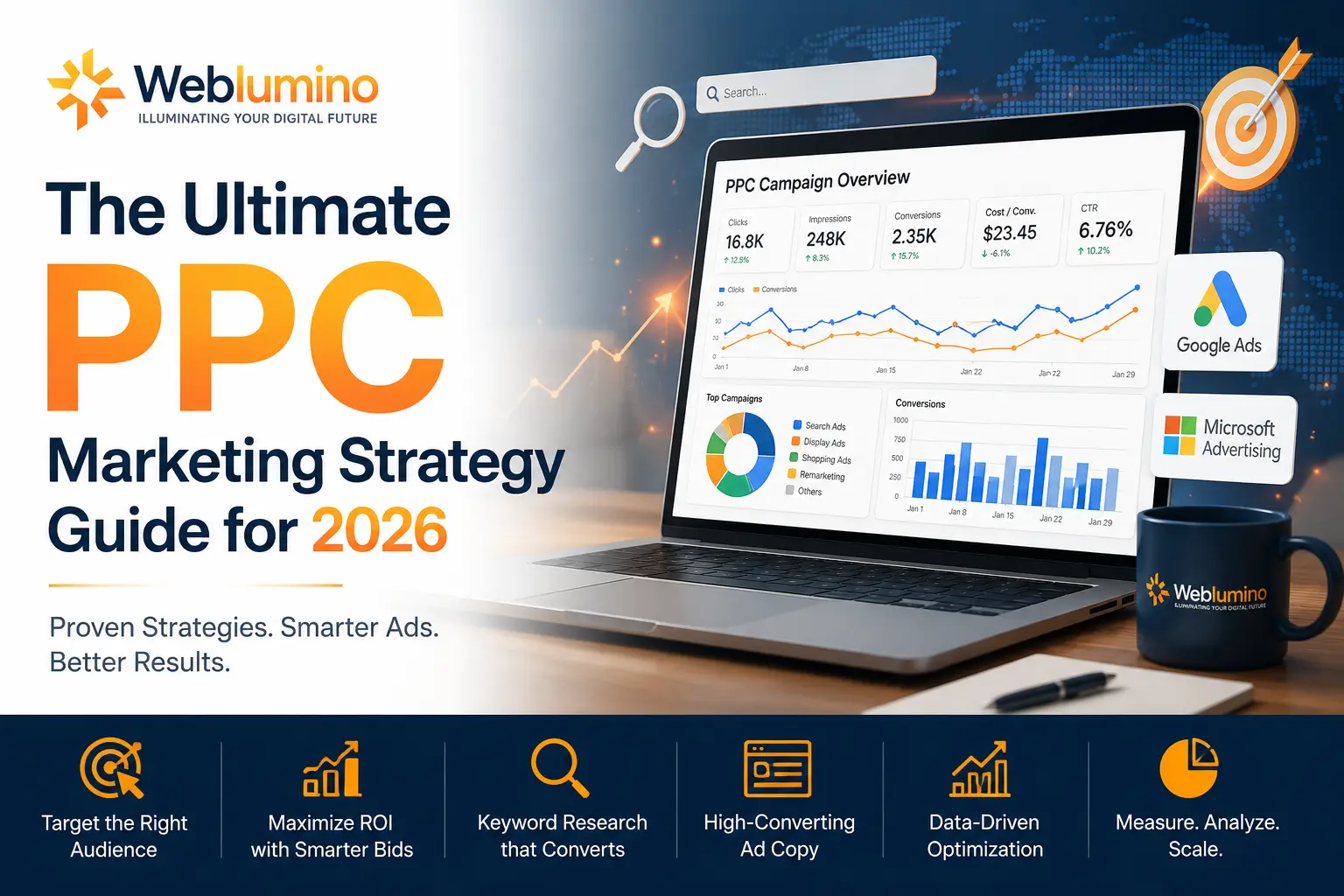
Pay-per-click advertising has changed more in the last two years than in the previous ten. AI now sets bids, writes ad copy, and decides who sees your ads before a human touches the campaign. If your PPC marketing strategy still looks the same as it did in 2023, you’re leaving budget on the table.
In this guide, we go through what works today: the Google Ads campaign structure & Quality Score and audience targeting, along with the PPC trends 2026 marketers cannot ignore. This is all practical from our day job at Weblumino LLP, where we make these strategies for clients every day, not theoretical.
What Is PPC Marketing, and Why Does Strategy Matter More Than Ever?
Pay-Per-Click(PPC): It is a pay-per-click search advertisement model wherein you only pay when someone clicks your ad. It is at the center of search engine marketing (SEM), which encompasses channels such as Google Ads, Microsoft Ads, and paid social.
The catch all these platforms have automated much of the manual labour, so non-strategic campaigns are now not just underperforming but doing very badly. Automation optimizes to whatever goal and data you give it; garbage inputs still produce garbage results. Strategy defines the difference between advertisers who scale up and do so profitably versus just burning budget.
Building a Google Ads Campaign That Actually Converts
The fundamentals of effective PPC campaign management that you begin even before writing a single ad.
One campaign, one main goal. Different structures and bidding strategies are required for various objectives like lead generation, e-commerce sales, and app installs. Combining goals in a single campaign confuses the algorithm about what you intend and delays data collection.
Organize according to intention, not products. Only group your ad groups in the category instead of searching intent (research vs ready to buy). This hones your keyword bidding strategy and maintains CPC within limits.
Choose the right bidding model. Manual CPC, Enhanced CPC, or automated Smart Bidding (Target CPA, Target ROAS, Maximize Conversions), the right choice depends on conversion volume. Automated bidding needs data; with fewer than 15-20 conversions a month, it often underperforms manual control.
Craft ads in alignment with search intent. Each headline should respond to the actual question driving the click. Certain ads receive more clicks and lead to conversions, so those ads contribute to a better Quality Score.
Quality Score Improvement: The Multiplier Most Advertisers Ignore
Quality Score has an impact on both your ad rank and your CPC. Means you’re paid less for the same position. Three factors drive it:
- Expected CTR — the quality of your ad copy and how relevant it is to potential customers
- Ad relevance — how well your ad matches the intent of a keyword
- Landing page experience — speed load, mobile-friendly site, and reader-content match.
Even a point or two toward Quality Score can realistically reduce CPC. Before you touch bids, audit your landing pages for speed and relevance; it’s usually the weakest link.
PPC Optimization Techniques That Move the Needle
After the campaign is live, PPC optimization continues to tweak and adjust until performance improves (or fades).
- Negative keywords weekly. It only takes a few days for search term reports to reveal wasted spend before it compounds.
- Ad copy testing. Always run two to three variations of responsive search ads per ad group and allow the performance data (when mature) to tell you which one wins.
- Adjust bids for device, location, and time. Performance is rarely distributed evenly; shift budget to what actually converts.
- Landing page testing. When testing things like headlines, forms, and page speed, small tweaks often make a greater impact on your conversion rate than bid changes.
- Impression share monitoring. Losing impression share to budget or rank, there’s an actionable signal there on what to do next.
Conversion Rate Optimization (CRO): Where the Real ROI Lives
A spend on traffic that is NOT converting is a waste. This is where conversion rate optimization (CRO) comes in; it focuses on optimizing everything that happens after the click:
- A landing page message that exactly matches the ad that caused the click
- Making form fields needless
- But one of our directives was to include a clear, singular call-to-action above the fold.
- Time-tested trust signals such as reviews or case studies placed right near the
There will always be synergy between CRO and PPC. A 1% increase in conversion rate can easily outweigh a 20% reduction in CPC.
PPC Audience Targeting and Remarketing Campaigns
PPC audience targeting in the modern age encompasses far more than keywords. By layering in audience signals, you hone in on who sees your ads and at what cost.
- You’re trained on: In-market audiences – overt signals that they are researching products similar to yours
- Customer match: Choose whether to target or exclude using your own CRM and email file
- Similar audience: built to extend reach on top of your best existing customers
- Remarketing campaigns: bring back site visitors that did not convert, often at a fraction of the CPC that you would spend on cold traffic
Since remarketing is aimed at those already aware of your brand, it has always provided an excellent ROI. Instead of catering to the same type of visitor, write segment-based lists: cart abandoners, blog readers, past purchasers.
PPC Trends 2026: What’s Actually Changing
Three forces are transforming the PPC landscape in 2026: AI automation, search answers written by AI, and tighter data privacy.
AI campaign management is the default now. Bidding, targeting, and creative generation increasingly run through AI. The advertiser’s job has shifted from manual control to feeding the system clean data and clear goals.
Ads are appearing inside AI-generated search answers. As search shifts toward direct answers rather than pure link lists, click patterns are changing — test placement within these surfaces rather than assuming old SERP behavior still applies.
First-party data is now a competitive advantage. With third-party cookies fading, businesses that actively collect their own customer data — email lists, CRM data, on-site behavior — have a real targeting edge.
Predictive, intent-based targeting is overtaking pure keyword matching. Platforms increasingly infer intent from behavioral signals, so strong audience and conversion signals matter more than exhaustive keyword lists.
Video and short-form creative are pulling more attention than static text ads across search and display networks.
Omnichannel campaigns outperform siloed ones. Connecting Search, YouTube, Display, and paid social into one coordinated strategy consistently beats running each alone.
Why Your Website Determines PPC Success
Of course, even if your PPC campaign could not be more optimised, it will all be for nought if the experience once on site is lacking. Two factors matter most:
Responsive web design can help you preserve both Quality Score and the conversion rate because it allows your landing pages to render correctly on each screen size. Website design optimized for mobile is a must. More than half of all paid search clicks now occur on smartphones, and a slow or awkward-loading mobile page can ruin the benefits your campaign has obtained with its new customers.
Combining executionally powerful PPC with solid Search Engine Optimization also pays dividends over the longer term, while SEO lays the foundations for lasting organic visibility, a well-executed PPC program generates instant, testable traffic.
Final Thoughts
Winning in 2026 with PPC marketing is not bidding at all once you set the goal and feed the platforms clean data, ongoing optimization on landing pages, and Quality Score while layering additional audience targeting that supports retargeting. You know what kind of ROI we are consistently seeing for advertisers that view AI as a tool to inform strategy, not something to be replaced with it?
Here at Weblumino LLP, we help businesses create and maintain PPC campaigns that utilize platform-level automation with direct strategic management, as the strongest results still come from melding smart tools with smart decisions.
Frequently Asked Questions
Turning on automated bidding too early, before there’s enough conversion data to learn from. Below 15-20 monthly conversions per campaign, automation often underperforms manual bids.
It depends on your industry’s average CPC and conversion rate, not a fixed rule. Estimate your target monthly conversions, multiply by average CPC, then add a 20-30% buffer for early testing.
Quality Score (1-10) measures ad relevance and landing page quality. Ad rank is your actual position, calculated from Quality Score, bid amount, and expected impact of ad extensions.
Yes, but their role has shifted. Keywords still define intent and structure, while platforms layer behavioral signals on top. Treat them as the foundation, not the entire strategy.
Check search terms and budget pacing weekly. Review bidding performance and audience segments monthly. Do a full creative and structural refresh quarterly.
Yes, often more than cold traffic. Remarketing campaigns typically convert at a lower CPC since they target people already familiar with your brand.
Improve Quality Score through better ad relevance and landing page experience first, then trim waste with negative keywords. Cutting bids directly usually just reduces visibility.
As connected but separate campaigns. Search captures active intent; Display and YouTube build awareness and support remarketing. Shared audiences and consistent messaging tie them together.
Google factors mobile usability into Quality Score, and a slow mobile page raises bounce rate and CPC. Since most paid search clicks are now mobile, a non-responsive landing page can undercut a well-targeted campaign.
Yes, PPC data on converting keywords and messaging can inform SEO content, while strong organic rankings reduce reliance on paid clicks for high-intent terms over time.
About the Author
This article is written by the Content & Digital Marketing team at Weblumino LLP, a digital marketing agency specializing in SEO, GEO, and AI search visibility strategy for growing brands. Get in touch with our team.