

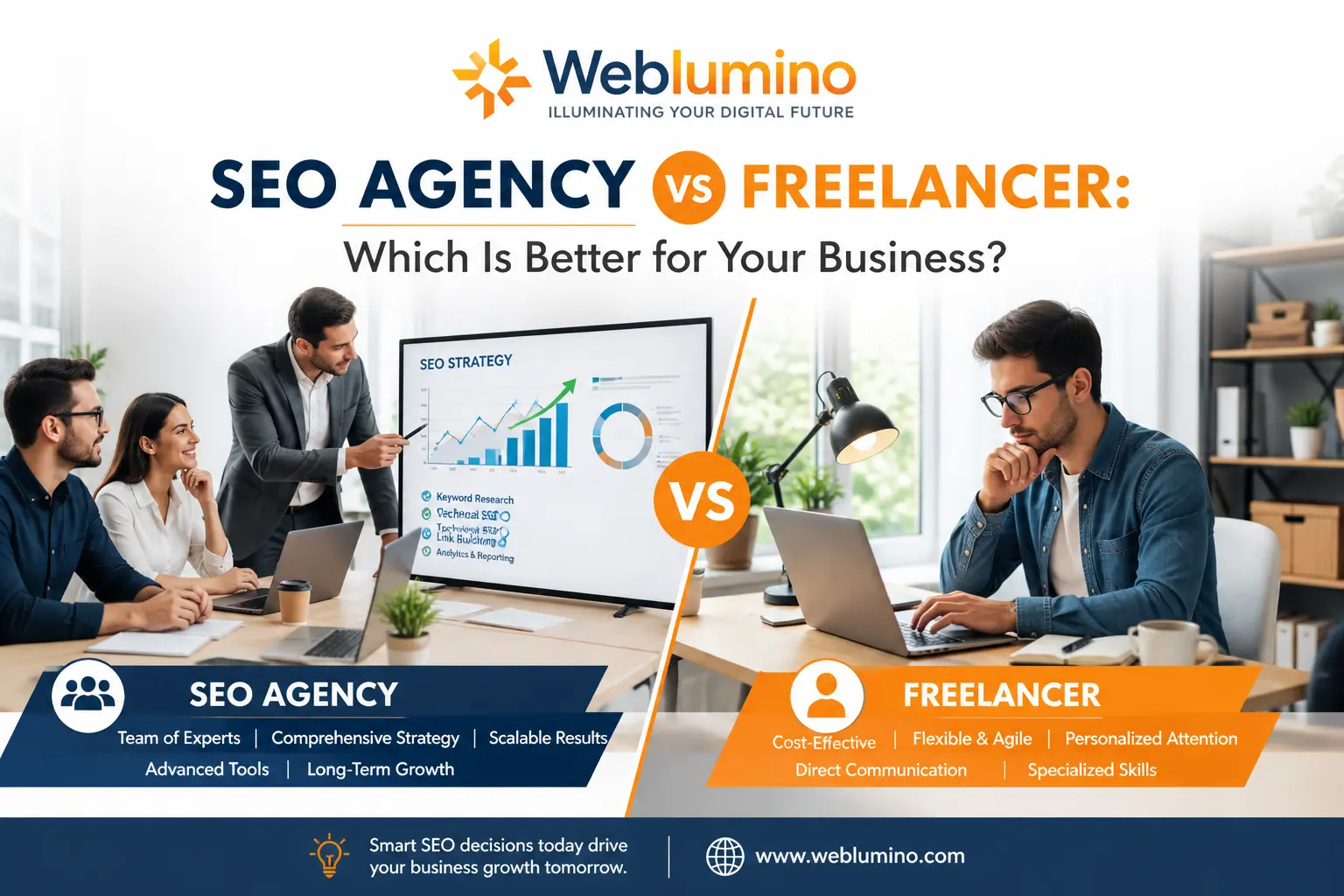
The SEO agency vs freelancer decision is one of the first real choices a growing business makes when it commits to search engine optimization. Get it right, and you build organic traffic, leads, and revenue that compound for years. Get it wrong, and you waste months (and budget) on a mismatch between what your business needs and what your provider can deliver.
Not one plan fits all people. Freelancers often do well if your site is small, you have a tight budget, and you want to keep the SEO work simple. Most of the time, the tasks are not hard. The targets are also clear and easy to define. An SEO agency can work better when the space is packed. If your site is large, you need more technical help, or you run an online store, an agency setup may feel smoother. Firms with many locations usually need the same kind of work in each region. With a team, you can move quicker and handle more tasks.
Start by checking your company size. Then ask how much SEO effort you expect. Price is a factor. Your growth goals matter too, and so does the timeline for results. Choose what fits your needs. This should cover the real parts, like cost, team skills, how you might grow later, technical SEO, content work, link tasks, and report updates. It should also spell out how you will work day-to-day with the team, plus who owns each piece. The aim is to guide your own choice, not to point at a generic case. Weblumino wrote this. They are a digital marketing agency. They offer SEO, PPC, web design, web development, and ecommerce marketing.
SEO Agency vs Freelancer: What’s the Difference?
An SEO agency is a firm with a set group of people. These workers handle tasks like technical SEO, content planning, link building, local SEO, and monthly reporting plus analytics. They run one client’s search optimization effort as a team. They use the same workflow, shared tools, and the same account setup.
An SEO freelancer is a solo consultant. They do the SEO tasks themselves. They often work with fewer clients. Many focus on a narrow area. Common focuses include on-page SEO, technical checks, or improving content.
First, the two terms are used in similar ways, so it helps to set them side by side.
- SEO consultant: People often use this word as if it means “freelancer.” In some cases, the work is more of a planning and advice role. Other times it is closer to doing tasks day to day.
- SEO specialist: This usually points to one area where the person is very focused. That could be technical SEO, or link work, or another single lane. A specialist might work alone, or they might be part of an agency crew.
When you choose, the label matters less than what the person or company can actually do. An agency has a full team, repeatable processes, and the option to handle several parts of SEO at the same time. A freelancer can give more personal attention, tends to have lower costs, and often limits their work to a smaller set of hands-on skills.
SEO Agency vs Freelancer at a Glance
| Factor | SEO Agency | SEO Freelancer |
| Cost | Higher monthly investment; reflects team overhead | Generally lower cost; reflects solo capacity |
| Expertise | Multiple specialists across disciplines | Typically strong in one or two areas |
| Team | Dedicated team (strategist, technical SEO, content, outreach) | One person handling most or all tasks |
| Scalability | Can scale campaigns up quickly | Limited by individual bandwidth |
| Technical SEO | In-house technical specialists, dev resources | Varies widely by individual skill set |
| Content | Structured content strategy and production pipeline | Often good at on-page optimization; content volume is limited |
| Link building | Established outreach processes and relationships | Possible, but usually slower and smaller in scale |
| Reporting | Formal reporting dashboards and account management | Often more informal, direct updates |
| Communication | Structured (account manager, scheduled calls) | Direct, usually faster response from one person |
| Accountability | Backed by company processes and contracts | Dependent on one individual’s availability |
| Best suited for | Competitive industries, ecommerce, multi-location, larger sites | Small sites, simple projects, early-stage businesses |
SEO Agency vs Freelancer: 10 Key Differences
1. Cost
Some freelancers will ask for a smaller fee. Their day-to-day costs can be lower too. Still, many agencies ask for more. They use a larger team, and they pay for tools and staff so the work keeps moving. For SEO work, pricing is often put into a few common buckets. A few people charge by the hour. Others want one total for the whole job. Some set a flat fee each month.
A lot of agencies rely on a monthly retainer. That money goes to tasks done by several team members tied to your account. You usually also get help with planning, access to important tools, and ongoing reports. So you cannot say the choice is always cheaper. It may not be the best value either. The key point is what you actually receive. Next, the details are laid out.
2. Expertise and Skill Set
In general, agencies can cover more niche work, while freelancers often go deeper in one small area.
SEO is not just one task. It can include technical SEO, like site structure, Core Web Vitals, indexing, and crawl checks. It can also include on-page SEO, such as content work and meta tags. There is off-page SEO too, like links and digital PR. Then you have local SEO. Analytics also sits in the mix.
A freelancer can be very good, but they rarely match that full spread. Most freelancers focus on one or two parts. An agency is set up to handle many areas at once, with different people for each part. This matters most when a business SEO workload grows.
3. Team and Resources
In short, it works like this. An agency gives you a whole team. A freelancer gives you one person, plus their time and tools.
Agencies often have higher-end SEO software. They also tend to run internal checks. They can pull in design help or dev help when needed. A freelancer may have to hire those parts separately, or they may skip them. Freelancers usually dig in more closely. Because they are not juggling many clients, the work gets more direct attention from the same person.
4. Scalability
In short: Agencies usually move an SEO effort forward faster. Freelancers can hit their limits sooner because they work alone.
When your SEO work grows, an agency can shift people around or bring in extra help. That can include new content, more target areas, a bigger tech to-do list, or a wider set of products. A freelancer has a fixed week of hours. Once the plan needs more tasks, progress can slow, and work can pile up. This is most important for teams that expect strong growth in the next year or two.
5. Technical SEO
In short: Most agencies keep someone on technical SEO as a regular job. When you use freelancers, the skill can jump around a lot from one person to the next.
Technical SEO is more than a simple list. It includes how fast pages load, Core Web Vitals, crawl budget use, indexing troubles, structured data, site layout, and work during migrations. A lot of generalist freelancers miss key parts of this, unless they have already worked through it on real projects. Some freelancers really do technical SEO and can turn in solid work. Others spend most of their time on content, so deeper technical issues may require support from someone more focused. Agencies usually manage technical SEO in-house, mainly for large sites or sites with a lot of moving pieces.
6. Content Strategy
In short: Agencies usually set up tight content workflows that can handle large output each month. Freelancers often do well with edits and updates to work that already exists, but they may not keep up with big production goals alone.
Building a complete content plan is not quick. It can mean keyword research, topic groups, editorial schedules, project outlines, new drafts, on-page tweaks, and internal links. Agencies tend to staff this with a strategist and writers so the work can run at scale. A freelancer may still do strong strategy and optimization for smaller sites, but keeping a steady high output week after week is tougher without a team.
7. Link Building
In short: Agencies often have solid outreach ties already in place. They also tend to run link building programs at scale without much disruption. Freelancers can do the work too, but links usually come in slower.
Link building is not just a one-time task. It relies on real contacts, a steady outreach routine, and time spent each week. Firms that focus on digital PR often benefit from past connections and repeatable workflows. A freelancer may still get strong results with careful targeting, but they usually cannot match the same pace or total output.
8. Reporting and Analytics
In short: Agencies usually send more formal reports. They often use dashboards, and they also assign an account manager.
Freelancers are more likely to share updates in a looser, more direct way. Either style can work well. The key is that the numbers are truthful. Also, the team should link results to real KPIs. Think organic traffic, keyword positions, qualified leads, and conversion rate. Avoid reports that chase vanity metrics. Pick a provider, agency, or freelancer that can show work using Google Search Console and Google Analytics. They should connect what they do in SEO to business results. Not only rankings.
9. Communication
In short: Freelancers usually answer quicker and in a more straightforward way because you deal with the actual person working on your task. Agencies more often go through an account manager, or they route updates through set contacts.
Both paths have downsides. If you hire a freelancer, you can reach the right person fast, but you also rely on their schedule. If you hire an agency, messages may go through a manager first. That can feel a bit more formal, yet it can keep things moving even when one person is off.
10. Accountability and Risk
In short: Agencies usually bring clearer structure. You get contracts, defined steps, and often extra people who can step in. When you hire freelancers, it can be just one person doing the whole job. That setup can create a single point of failure. But there is another side too. A lot of freelancers feel tied to the client’s rhythm and the daily tasks.
If your freelancer is out for a while, for example, due to sickness or a packed calendar, you may not have a quick substitute. If they switch to another job, your SEO work might slow down or stop. Some agencies deal with this in a better way since the work is not held by one staff member only. Still, some freelancers take real ownership and can shift sooner. That kind of quick change is not always easy in a larger company.
When Should You Hire an SEO Freelancer?
A freelancer can be the right call in several common situations:
- You start with limited funds, so a full agency retainer does not work well right now
- You only need one SEO push, such as a technical audit or a quick keyword review
- The job is clear and focused, not a long blend of many services
- You want to speak with the person who will do the work, not a middle team
- New businesses are still checking their market, and SEO needs can change fast, so a smaller plan fits better
With these choices, a freelancer can still deliver solid results that match your goals, without paying for a larger setup.
When Should You Hire an SEO Agency?
An agency tends to be the stronger fit when:
- You operate in a competitive industry where multiple specialists working together provide an edge
- You run an ecommerce store with a large product catalog, technical SEO needs, and ongoing content demands
- You manage a large or complex website requiring dedicated technical SEO resources
- You operate multiple locations and need coordinated [local SEO across multiple locations](Local SEO URL)
- You need international SEO, involving multiple languages, regions, or country-specific search behavior
- Your business requires large-scale content production that a single person couldn’t sustain
- Local SEO is a priority, and you want dedicated resources for Google Business Profile management, citations, and local content
- You’re focused on long-term, sustainable lead generation rather than a short-term project
- You want SEO coordinated with other digital marketing channels — PPC, web design, web development, or ecommerce marketing — under one strategy
If your business fits several of these criteria, the coordination and capacity an agency provides usually outweighs the higher cost.
SEO Agency vs Freelancer: Which Is More Cost-Effective?
Some people keep bringing up the lower price. But that is not the main issue. The point is more direct. What option gives the best result for the money you pay? The answer can change. It depends on the size of the job, who on the team will actually do the work, and what comes after you ship the work.
Cost alone can mislead you. Paying less can still leave you with weak results. Paying more does not automatically mean you will get strong results either. So do not stay at the top layer. Look at what is included. Then decide if it matches what your business needs right now.
Try to assess it with a few practical points, not just the final numbers.
- Start with the amount of work. The scope often matters more than the hourly rate. A freelancer with a low hourly fee might handle small on-page edits only. An agency that charges a higher retainer may bundle technical SEO, content tasks, link building, and ongoing updates into one plan.
- Accountability affects risk. If a freelancer becomes unavailable mid-campaign, the business may lose momentum with no easy replacement. An agency’s structure typically reduces this risk.
- Scalability affects long-term ROI. A business expecting significant growth may find a freelancer’s fixed capacity becomes a ceiling, requiring a later switch to an agency — with re-onboarding costs and lost time.
- Pricing models vary considerably between hourly rates, fixed project fees, and monthly retainers, and aren’t directly comparable without knowing what’s included. Accurate ranges depend on your industry, competition, and location — any provider you evaluate should clearly explain what’s included in their pricing and why.
The most reliable way to judge cost-effectiveness is to compare projected outcomes relative to price — organic traffic growth, qualified leads, and conversion rate — not the sticker price alone.
SEO Agency vs Freelancer for Different Types of Businesses
Small Local Business
Either option can work, depending on complexity. A freelancer often suffices for a single-location business with a straightforward website and a defined local SEO need. If you also want ongoing content, PPC, or [website improvements alongside SEO](Website Design URL), an agency offering these under one roof may be more efficient.
Real Estate Business
A freelancer with local SEO experience can suit a single-agent or small brokerage. Larger real estate businesses with multiple agents, listing pages, or markets typically benefit from an agency’s combined local SEO and content capacity.
Medical/Healthcare Business
Healthcare is a YMYL (“Your Money or Your Life”) category, where Google applies stricter quality standards around accuracy and trustworthiness. An agency with experience in regulated industries is often the safer choice for larger practices, though an experienced healthcare SEO freelancer can also work well for a single-practice website.
Ecommerce Store
Ecommerce SEO typically involves large product catalogs, technical SEO (faceted navigation, duplicate content, site speed), and ongoing content needs. This complexity generally favors an agency, especially as the catalog and competition grow. A freelancer may be workable for a small store with a limited product range.
B2B Company
B2B SEO often prioritizes long-tail keyword research, content strategy, and lead generation over transactional conversions. A freelancer with strong content and strategic skills can work well for a smaller B2B business, while companies with longer sales cycles or larger content libraries often benefit from an agency’s structured capacity.
Multi-Location Business
Coordinating local SEO — Google Business Profiles, location pages, citations, and reviews — across multiple locations is resource-intensive and generally better suited to an agency with systems and staff dedicated to managing it at scale.
Enterprise Business
Enterprise websites typically involve significant technical complexity, large content libraries, and multiple stakeholders. An agency is almost always the more practical choice at this scale, given the breadth of expertise and resourcing required.
Questions to Ask Before Hiring an SEO Agency or Freelancer
Whichever direction you’re leaning, ask these questions before signing an agreement:
- What SEO strategy will you use for my specific business and goals?
- How will you measure success, and which KPIs will you track?
- What does your monthly SEO process actually include?
- Do you provide technical SEO, or only on-page/content work?
- How do you approach content strategy and content creation?
- How do you approach link building, and what methods do you use?
- What reporting will I receive, and how often?
- Can you show relevant case studies or examples of past work with results you can verify?
- How do you handle Google algorithm updates when rankings shift?
- What access will you need to my website, Google Search Console, and Google Analytics?
- What happens if I want to cancel or pause the engagement?
- Who will actually be doing the work — will I be speaking with the specialist or an account manager?
A confident, specific answer to each of these is a stronger signal of reliability than pricing alone — whether you’re evaluating a freelancer or an agency.
SEO Agency vs Freelancer: Which Should You Choose?
Use this decision framework as a starting point:
Choose a freelancer if:
- Your website is small, and your SEO needs are relatively simple
- You have a limited budget and need to start somewhere
- You have a single, well-defined project rather than an ongoing multi-discipline campaign
- You strongly prefer direct, one-on-one communication
- You’re an early-stage business still testing your market
Choose an agency if:
- You compete in a crowded or competitive industry
- You run an ecommerce store, a large website, or multiple locations
- You need technical SEO, content, and link building running in parallel
- You want SEO coordinated with other channels like PPC or web design
- You’re focused on long-term, sustainable growth and want built-in scalability
Choose based on project complexity if:
- Your needs are genuinely somewhere in the middle. In that case, look less at the label (“agency” vs “freelancer”) and more at whether the provider — of either type — can demonstrably cover the specific disciplines your website needs, with the capacity to scale if your business grows.
Talk to an SEO Expert at Weblumino if you’re unsure which category your business falls into — a short conversation about your goals, site, and competition usually clarifies the right fit faster than researching alone.
Frequently Asked Questions
Not universally. Agencies tend to suit complex, large-scale, multi-discipline needs; freelancers can be equally effective for smaller, simpler projects. It depends on your business’s size and SEO complexity.
Generally, yes — freelancers typically have lower overhead, reflected in lower rates. But total cost depends on scope, so a lower rate doesn’t always mean lower total cost if extra specialists are needed later.
Pricing varies widely by experience, location, and scope, typically structured as an hourly rate, project fee, or monthly retainer. Because it varies so much by market and provider, request quotes directly rather than relying on general figures.
Agency pricing is usually a monthly retainer reflecting the combined time of multiple specialists, tools, and reporting infrastructure, varying by scope, competitiveness, and business size. As with freelancers, get accurate pricing through a direct conversation.
An SEO agency manages search engine optimization campaigns using a team of specialists covering technical SEO, content strategy, link building, local SEO, and reporting, typically coordinated through structured processes and account management.
An SEO freelancer independently manages SEO tasks for clients, often specializing in one or two areas such as on-page optimization, technical audits, or content, and typically handles a smaller volume of work directly.
It depends on their expertise and available time. Some experienced freelancers manage larger sites well, but a large or highly technical website’s workload often exceeds what one person can sustainably handle alongside other clients.
A small business should consider an agency when its SEO needs grow beyond a single discipline — for example, needing technical SEO, content, and link building simultaneously — or when it operates in a competitive market that requires more resources than a freelancer can provide.
DIY SEO can work for very small, low-competition websites if you’re willing to invest real time learning the discipline. For competitive markets or growth-focused businesses, professional support typically produces faster, more consistent results.
Compare providers based on their relevant experience, the specific disciplines they cover, their reporting process, and how clearly they explain their strategy — rather than choosing based on price alone. Asking the questions listed earlier in this guide is a practical way to evaluate any provider.
Final Verdict
In the SEO agency vs freelancer debate, neither option is inherently better — the right choice depends on matching provider capacity to business need. Freelancers offer lower cost, direct communication, and strong value for smaller, well-defined projects. Agencies offer broader expertise, greater scalability, and more structural accountability, which tends to matter more as a website, industry, or growth ambition becomes more complex.
There are no guarantees in SEO, regardless of who you hire — search rankings depend on many factors, including ongoing algorithm changes, competition, and consistent execution over time. What you can control is choosing a provider whose scope, expertise, and capacity genuinely match your business, and holding them accountable to clear KPIs rather than vague promises. That’s the approach Weblumino LLP takes with every client engagement.