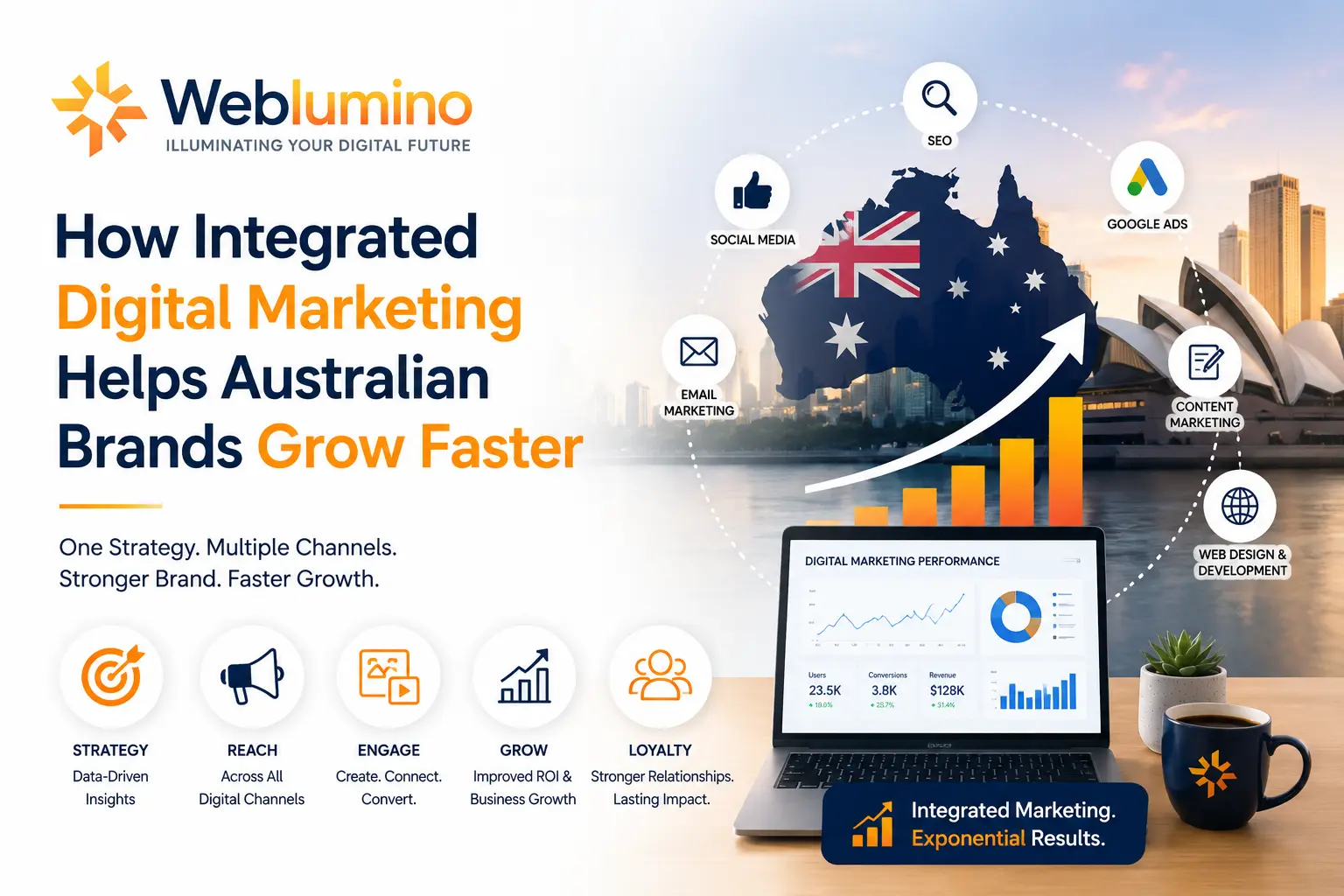
Australian businesses aren’t asking whether they should get into digital marketing; they’re asking how to work every dollar a bit harder. In line with this, WARC reveals that for the eighth quarter in a row (and rising 15.3% year-on-year), Q1 2026 has seen an unprecedented surge of $4.9bn entering digital ad spend immediately (before taking inflation into account), and critical to separated brands winning or simply existing seems to boil down to just one factor: integration.
Fragmented marketing running Google Ads here, posting on Instagram there, and doing a bit of SEO when time allows, produces fragmented results. This is precisely where integrated digital marketing helps Australian brands stop spinning their wheels and start building real momentum. Aligning every channel, message, and metric toward a single growth engine isn’t just a smarter approach for Australian brands serious about scaling; it’s now a strategic imperative. It’s the baseline.
What “Integrated” Actually Means (and Why It’s Misunderstood)
Most businesses think they’re doing integrated marketing because they’re active on multiple platforms. They’re not.
True integration means your SEO strategy informs your Google Ads copy. Your paid traffic lands on pages optimized for conversion, not generic homepages. Your email sequences retarget visitors who came from organic search. Your social content reinforces the trust signals that close leads from PPC campaigns.
Every channel feeds the next. Data flows between them. The result is a compounding effect that no single channel can produce in isolation.
The Australian Digital Landscape: Why Integration Matters More Here
Australia’s digital market has unique characteristics that make a siloed approach especially costly.
With approximately 26.2 million Australians online, representing 97.1% internet penetration, the audience is saturated. You are not fighting for attention in a growing market; you are competing for share in an already-too-crowded one. The fight will ultimately belong to the brands that orchestrate better, not to those that shout louder.
However, video is on the rise and already constitutes almost 29% of digital ad spend. In 2025, more than US$4.73 billion was spent on social media advertising, up 11% year-on-year. Meanwhile, the overall digital marketing market is forecast to expand at a compound annual growth rate CAGR of 6.9%, reaching USD 27.15 billion by 2035.
The figures speak for themselves: Australian consumers are transacting on many channels at the same time. So you have to know that a brand that is only visible on one channel is invisible to many large segments of its potential market.
The Five Pillars of Integrated Digital Marketing for Australian Brands
1. SEO Strategy That Builds Long-Term Visibility
Strong SEO is the foundation. Lowering your long-term acquisition cost, increasing brand authority and attracting hyper-targeted traffic that converts better than paid-only visitors.
Local SEO is a high-leverage strategy for Australian SMEs. Local SEO is a long game: you only have to optimize for suburb and city-level keywords once, build citations in Australian directories once, and get links from local publications that never expire. These provide compounding returns which ethereal paid media (no offence) do not afford you.
The key is treating SEO as infrastructure, not a campaign. Your keyword research should shape your content calendar, your landing page architecture, and even your Google Ads targeting.
2. Google Ads for Immediate Lead Generation
SEO builds over months. Google Ads delivers leads today. Combined, they cover the front and back end of your growth timeline.
The error nearly all brands make with Google Ads is to undergo a wide, unexpressed commercial and ask why the charge-per-lead is excessive. The importance of segmentation (finding the right audience), negative keywords, and, more importantly, optimized landing pages, if you want to succeed in PPC in Australia. One of the biggest reasons for Google Ads campaigns falling flat is sending paid traffic to a generic home page. For direct lead generation, search ads are still the strongest performing format.
Search ads are still the top-performing format for direct lead generation. Shopping campaigns combined with SEO-optimized product pages yield disproportionate returns for e-commerce brands.
3. Website Conversion Optimization
Unconverted traffic is nothing but an expenditure. But most Australian brands continue to overlook website conversion as a key part of their digital strategies.
CRO stands for conversion rate optimization, a process of making systematic improvements to the percentage of visitors who complete a desired action, such as submitting a form, calling, purchasing or booking. An improvement of just 1% in conversion rate will more than double revenue originating from the existing traffic, making it one of the highest-ROI investments at your disposal.
Integrated CRO connects Google Analytics with heatmapping tools and customer surveys to pinpoint friction points as well as test solutions. The already analyzed insights improve ad copy, email sequences, and SEO content directly.
4. Content Marketing and Authority Building
Australian consumers are increasingly research-driven. They Read, Compare, and Validate Before They Engage a Service Provider or Make a High-Value Purchase. Brands that create educational and authoritative content help build trust before any conversation takes place.
This is not the type of document where you just publish blog posts for the sake of publishing them. You need to map content to the buyer journey: Awareness-stage content that captures organic search traffic, consideration-stage content that nurtures leads via email, and decision-stage content that wins conversions.
SEO-friendly content also works for social ads, email marketing, and sales enablement. A single in-depth piece of content can drive a quarter or more of integrated activity.
5. Data, Analytics, and Closed-Loop Attribution
Integrated marketing is better than siloed marketing, not only because it’s more strategically aligned but also and principally because it can be measured. By sharing data between your channels, you can see exactly what mix of touchpoints influences conversions and spend accordingly.
It’s this closed-loop attribution model that differentiates the teams and/or brands that grow faster than they are going sideways. It removes the guesswork from budget decisions and gives marketing teams clear evidence of what’s working.
Small Business Growth: What Integration Looks Like in Practice
Here is an example of what an integrated strategy might be for Australian small businesses:
- Weeks 1 – 4: Technical SEO audit performed + on-page optimization completed; Google Ads campaign drives traffic to the new site (initial budget: $50–$100 / day targeting highest-intent local search terms).
- Month 2–3: Publish content targeting mid-funnel search queries; conduct an A/B test on landing pages to get a better conversion rate
- Month 3–6: Email Automation Sequences created to nurture leads who don’t buy right away; Retargeting Campaigns for website visitors.
- Month 6 on: The URL generates consistent organic leads from SEO, we’re reallocating our paid budget towards expansion campaigns, and we have the attribution data to inform the next growth phase.
This isn’t theory. These are the sort of repeatable playbook that has powered business lead growth for countless Australian SME companies in fields like retail, professional services, trades and ecommerce.
Why Weblumino LLP Takes an Integrated Approach
Weblumino LLP is a full-funnel marketing agency, meaning we don’t silo channels. All of our engagements begin with a full-funnel audit, getting a deep understanding of how the leads are flowing through, where they drop off, and what it would take to double the conversion rate at each step before scaling spend.
We offer Australian brands a suite of digital marketing services, including SEO strategy, Google Ads management and more, as well as performance analytics. All of this is meant to fit in with each other because it is the only way it has ever worked reliably.
If your agency is managing your Google Ads without influencing your landing pages, or executing SEO without informing your content strategy, you’re missing out on massive growth!
Frequently Asked Questions
Integrated digital marketing means coordinating all your online marketing channels — SEO, paid ads, content, email, social media — around a unified strategy and consistent messaging. For Australian businesses competing in a near-saturated digital market, integration ensures every channel amplifies the others rather than working in silos. The result is lower cost per acquisition, higher conversion rates, and more sustainable growth.
Paid channels like Google Ads can produce leads within the first week. SEO typically delivers meaningful organic traffic growth within 3–6 months, depending on competition and domain authority. The compounding benefits of integration where SEO and paid work together, where content feeds email, where CRO improves every channel become visible at the 6–12 month mark. Brands that commit to an integrated approach for 12 months consistently outperform those that switch strategies every quarter.
Yes — and in many ways, small businesses benefit more from integration than large ones. With limited budgets, every dollar needs to work harder. An integrated approach ensures paid traffic lands on high-converting pages, SEO reduces long-term ad dependency, and email retention reduces churn. Small businesses that integrate early build a competitive moat that becomes increasingly hard to overcome.
SEO builds organic search visibility over time. Google Ads delivers immediate paid placement. Used alone, each has limitations: SEO is slow to start, and Google Ads stops working the moment you pause spending. Together, they cover both short-term lead generation and long-term growth. For most Australian businesses, running both simultaneously with SEO insights informing ad targeting produces the best results.
The most important metrics vary by business goal, but typically include: cost per lead, conversion rate (website visitors to enquiries or sales), organic search traffic growth, return on ad spend (ROAS) for paid campaigns, and customer acquisition cost (CAC). A well-integrated strategy should show improvement in all of these over time. If you’re only measuring clicks or impressions, you’re not measuring growth — you’re measuring activity.
The most common and costly mistake is treating each marketing channel as independent and measuring them separately. Running Google Ads to a non-optimized homepage, doing SEO without a content strategy, publishing on social media without connecting it to lead generation — these approaches produce mediocre results at best. The second biggest mistake is changing strategies too frequently. Integration requires 3–6 months to show its full effect. Brands that constantly shift tactics based on short-term results rarely build the momentum that produces lasting growth.
For e-commerce brands, SEO services targeting product and category pages are among the highest-ROI investments available. Organic product listings generate traffic without a cost-per-click, and high-ranking category pages drive consistent volume that paid campaigns can supplement — rather than solely fund. Integrated ecommerce marketing combines organic product SEO, Google Shopping campaigns, and remarketing sequences to maximize revenue across the full customer journey.
Four trends are reshaping Australian digital marketing right now: (1) the rapid growth of retail media and first-party data strategies as privacy regulations tighten; (2) the surge in video advertising, which now accounts for nearly 29% of online ad spend; (3) AI-assisted content creation and campaign optimisation, which is raising the quality floor across industries; and (4) the increasing importance of omnichannel attribution understanding how multiple touchpoints combine to produce a conversion, not just which one was last.
Weblumino LLP is a full-service, performance-driven digital marketing agency with expertise in helping Australian Brands grow faster with data-driven, integrated SEO, paid search, and conversion optimization solutions. One that compounds for real, not wishing you were? [Get in touch today.]