
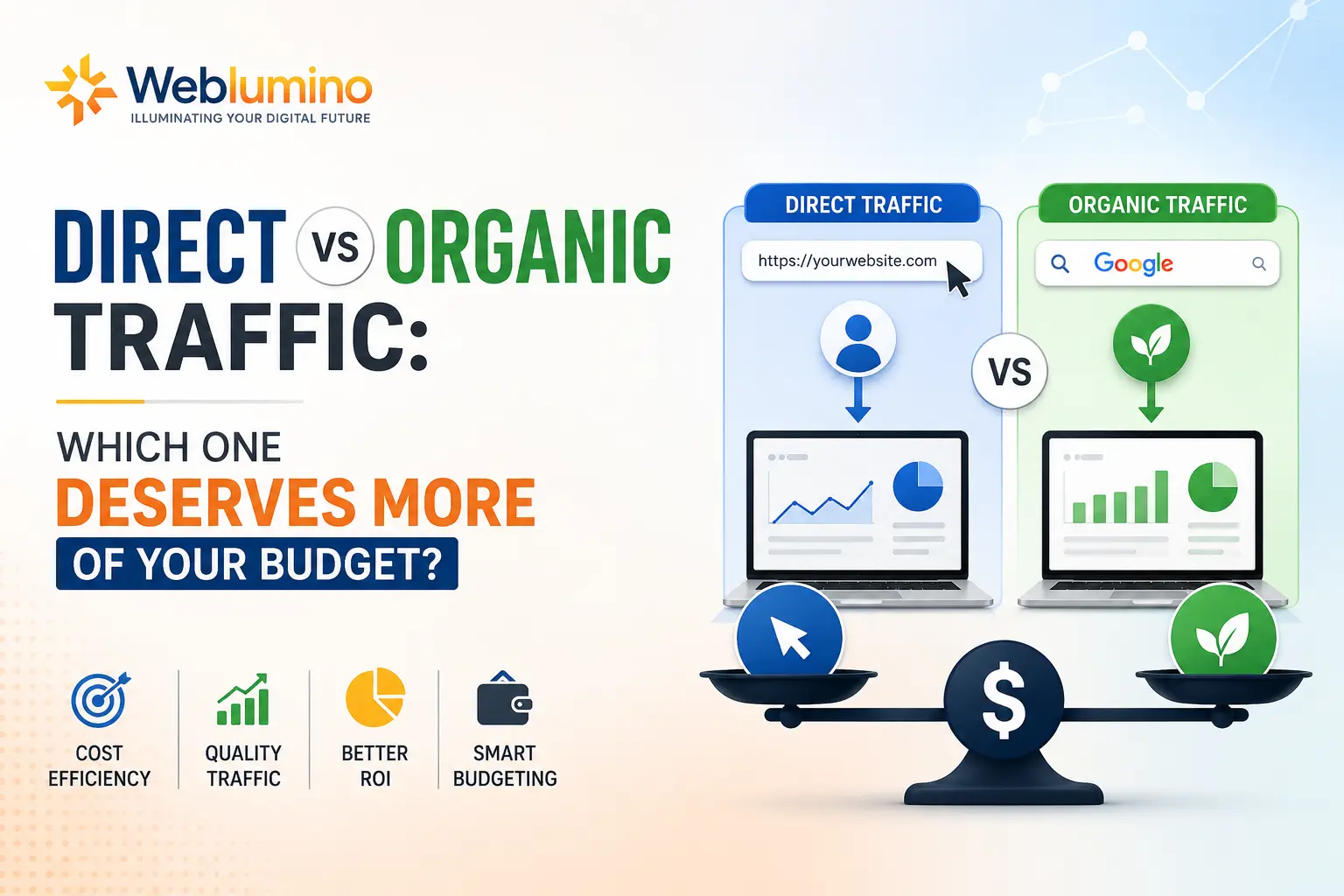
Have you ever opened Google Analytics, stared at your traffic sources, and said to yourself, “What does that even mean for my business?” You’re not the only one. Another thing you may mix up is direct traffic and organic traffic, another term bandied around by website owners from all parts of the globe. They both bring traffic to your site, but they have entirely different natures and completely different budgeting decisions.
Let us now guide you through everything you need to know about direct vs organic traffic in our complete guide: how both of these traffic sources work, how Google Analytics tracks each one, and which traffic source deserves most of your marketing budget from 2026 onwards.
Understanding Website Traffic Sources
So before we jump into the direct versus organic debate, let us get some context. Your website traffic is from various channels, such as organic search, by entering the URL directly in the browser, paid ads, referrals (mostly), social media, and email campaigns. Every source tells a different story regarding who your visitors are, how they found you, and what the outcome of their activity will be.
Marketing Tools: Web analytic tool, such as Google Analytics, divide these sources for marketers to make better budgetary decisions. Out of all traffic sources, organic and direct are probably the most misunderstood, partly because they can look alike at first glance while having very different business implications.
What Is Organic Traffic?
Organic Traffic: Visitors coming to your site by clicking an unpaid result in a search engine, such as Google, Bing, or Yahoo. Suppose someone searches with a keyword like best digital marketing agency in Delhi and clicks your result without you having paid for that click, then this simply means organic traffic.
It is referred to as “organic” because it develops naturally via organic search engine optimization (SEO) effort, not payment. Your technique/setup for delivering content that satisfies search engine SEO and your backlink profile determines how well you rank.
How Organic Traffic Works
Search engines crawl and index pages. Hence, during a search made by the user, thousands of pages are scored on factors such as authority, trust, and relevance. If your page clicks advance and ranks high, that visit will be tagged as Google Search Traffic in your analytics.
Organic traffic is powered by:
- On-page Search Engine Optimisation — keyword targeting, headings and sub-headings, internal linking, content depth
- Technical SEO — all things site speed, mobile usability, crawlability, Core Web Vitals
- Off-page SEO — backlinks, brand mentions, and domain authority
- Content Marketing — regularly producing useful and well-structured content that satisfies the real queries users have when searching
The most important point to know: organic traffic stops when your budget runs out. A well-placed page will bring in visitors month after month or even year after year with no continued ad spend. This is why SEO is one of the most effective channels across online marketing.
According to industry research, organic search still makes up some 53% of total website traffic, representing the largest single source of traffic for many businesses.
What Is Direct Traffic in Google Analytics?
In Google Analytics, direct traffic is defined as a session for which a referral source cannot be identified. This typically indicates that a user typed your URL directly into their browser, clicked on a bookmark link, or landed on your site from an untaged link.
Here’s what actually drives direct visits:
- Typing the URL directly (e.g., weblumino.com)
- Clicking a saved browser bookmark
- Clicking a link in a PDF or Word document without UTM parameters
- Email links that strip referrer data
- Links from HTTPS pages to HTTP pages (referrer gets dropped)
- Mobile app traffic without proper tracking
- Offline marketing efforts (business cards, print ads, TV/radio mentions)
The Attribution Problem With Direct Traffic
The attribution challenges for direct traffic are well understood – that is, direct traffic can be inflated by misattributed traffic. All that traffic from campaigns without UTM parameters, when someone copies a link through WhatsApp (which strips referrers), or secure-to-insecure redirects are also stripped of referral data, gets dumped into the “direct” bucket.
That’s why web analytics experts always advise adding UTM parameters to all campaign links. In their absence, your direct traffic stats can actually be misleading, obscuring the sources of true direct visits.
All that said, true direct traffic from people who know your brand well enough to actively type your URL is a very strong trust signal. This reflects strong brand loyalty, repeat visitors, and high intent.
Organic Search vs Direct Visits: Key Differences
| Factor | Organic Traffic | Direct Traffic |
| Source | Search engines (unpaid) | Typed URL, bookmarks, untracked links |
| Intent | Informational to transactional | Usually high intent or returning visitor |
| Brand awareness | May or may not know your brand | Strong brand familiarity |
| Attribution data | Rich keywords, queries, behavior | Limited no referral path |
| Cost | Time + SEO investment | Often, the result of prior marketing |
| Scalability | Scales with content and authority | Scales with brand-building |
| Sustainability | Long-term | Depends on brand recall |
This indicates you are in different stages of the customer relationship with both traffic types. Organic traffic will generally put your brand in front of audiences who may have previously not heard of you. Direct traffic is usually made up of people who already know you and trust you.
Improving Organic Website Traffic
It may take time to build organic traffic, but that effect snowballs over time. Now here are the best strategies:
1. Keyword Intent — Build a Keyword Strategy That Fits the Search Intent. Don’t just target high-volume keywords. For any of the keywords, map them to what the user actually wants. Are they looking for information, doing a comparison, or just making a purchase decision? Create content that answers those questions directly.
2. Publish Pillar Content Pieces as well as Topic Clusters. Organize content in silos grouped by core topics. For example, a site may have pillar pages on Digital Marketing for Small Business, which are backed up by cluster posts on SEO, social media, and email marketing.
3. Address Technical SEO Essentials: Fix crawl issues, optimize page speed, enable mobile usability, and install Structured Data markup. Even if you have fantastic content, technical problems are quietly killing your organic rankings.
4. Quality Links Gain links from high-authority websites relevant to your industry with guest posting, digital PR, primary research, and linkable assets. Backlinks are still one of the most powerful ranking signals for Google.
5. Revisit Old Content: Continue to repurpose older posts with new figures, richer examples, and some of the latest data. Having fresh content is a ranking factor, particularly for competitive keywords, and Google rewards freshness.
Measuring Website Traffic Performance
Tracking your traffic isn’t just keeping an eye on numbers. Which is knowing what’s working, what isn’t, and where to make your next investment.
Key metrics to monitor in Google Analytics:
- Sessions by channel — How much traffic comes from organic vs direct vs other sources
- Bounce rate per source — Are organic visitors engaging or leaving immediately?
- Pages per session — Direct visitors often view more pages (higher familiarity)
- Goal completions — Which traffic source converts best for your business goals
- Keyword performance — Track which queries bring organic visits via Google Search Console.
A natural partner for analyzing organic traffic is Google Search Console, which includes data on keyword performance. It includes impressions, clicks, average position, and the specific search queries that trigger your pages, which are not available from Google Analytics on its own.
SEO and Traffic Analysis: Which Deserves More Budget?
This is the short and honest answer: it depends on your business stage, objectives, goals, time horizon, etc. But for most businesses, organic traffic provides better ROI in the long-run.
Invest more in organic (SEO) when:
- You’re building long-term sustainable growth
- You want to reduce dependency on paid advertising
- You’re in a competitive market where brand trust matters
- You have content assets that can rank and compound over time
Direct traffic grows as a result of brand investment. You will not be able to buy direct traffic directly. It’s a byproduct of doing everything else right, strong SEO, amazing content, an active social media presence, for example, offline brand-building, and providing an experience that people will be able to recall to return for.
The best digital marketing strategies see organic traffic as fuel and direct traffic as a gauge. When your direct traffic grows alongside your organic traffic, it means your brand is earning recognition, not just rankings.
Website Traffic Growth Strategies: Putting It All Together
Here’s a practical framework for growing both traffic types simultaneously:
- SEO + Content Marketing → Drives organic traffic from new audiences
- Email Marketing with UTM tags → Properly attributed; keeps repeat visitors engaged
- Brand consistency across channels → Builds recognition that drives direct visits
- Social media presence → Amplifies content, builds brand recall
- Offline marketing → Print, events, word of mouth → drives direct URL visits
- Regular analytics review → Monthly audits of Google Analytics to spot drops, opportunities, and misattributed traffic
Frequently Asked Questions
Direct traffic refers to visitors who reach your website without a traceable referral source. This includes people who type your URL directly into a browser, use bookmarks, or click untracked links from emails, PDFs, or apps. It’s often a sign of strong brand recognition, repeat visitors, or offline marketing impact, and can also include misattributed traffic when UTM parameters aren’t in place.
Organic traffic comes from users who click on your website through unpaid search engine results. When your page ranks on Google for a relevant query, and someone clicks it, without you paying for that placement, it counts as organic traffic. It’s built through SEO, content quality, technical optimization, and domain authority over time.
The core difference is the source and what it tells you. Organic traffic originates from search engines via unpaid rankings, which reflects your SEO performance and search discoverability. Direct traffic has no identifiable source; the user typed your URL, used a bookmark, or the referral data wasn’t captured. Organic traffic introduces you to new audiences; direct traffic reflects brand loyalty and recall.
Organic traffic is directly tied to SEO performance. Higher organic traffic means your SEO strategy is working, your content is ranking, earning clicks, and satisfying search intent. Direct traffic isn’t a direct SEO metric, but a growing direct traffic share often signals that your brand is gaining authority, which indirectly supports SEO through branded searches and higher engagement from return visitors.
Google Analytics uses the referrer header sent by browsers to identify traffic sources. If a referrer is present (e.g., google.com), it’s classified as organic or referral. If no referrer is detected, the session defaults to “direct.” Campaign parameters (UTM tags) override this and accurately label traffic by source, medium, and campaign. Without UTM tags on marketing links, a significant portion of your campaign traffic may incorrectly appear as “direct” in your reports.
Growing organic traffic requires a consistent, multi-pronged approach: conduct thorough keyword research aligned to search intent, publish high-quality content that answers real queries better than competitors, earn quality backlinks through outreach and digital PR, fix technical SEO issues (site speed, crawlability, Core Web Vitals), implement structured data markup, and regularly update existing content to stay relevant. Consistency and topical depth matter more than frequency alone.
Google has not directly confirmed that it doesn’t use Google Analytics data as a ranking signal. However, high direct traffic volume correlates with strong brand authority and user loyalty. Return visitors tend to engage more deeply, which improves behavioral signals like session duration and pages per visit, factors that may indirectly reflect content quality over time.
Apply UTM parameters on every external link in email campaigns, social posts, PDF downloads, and offline QR codes. Avoid HTTPS-to-HTTP redirects that strip referral data. Use consistent campaign tagging conventions across your team. Audit Google Analytics regularly to identify unusual spikes in direct traffic that may indicate tracking gaps rather than genuine brand visits.
Organic traffic doesn’t cost per click, but it’s never truly “free.” It requires investment in SEO tools, content creation, technical optimization, and link building. The advantage is that compounding returns, a well-ranked article can drive traffic for years, making the cost-per-visit extremely low compared to paid channels. This is why SEO consistently delivers strong ROI over a 12-month or longer horizon.
For organic traffic: keyword rankings (Search Console), organic sessions, click-through rate, and goal completions from organic visitors. For direct traffic: session volume trends, bounce rate, pages per session, and conversion rate. Across both: compare month-over-month channel growth, track conversions per source in GA4, and use audience insights to understand how each traffic type behaves differently on your site.
Are you looking for how to increase organic traffic and establish a brand that will make your site so strong that it can still get visitors without any marketing efforts? Weblumino LLP is a full-fledged digital marketing agency where we offer internet marketing services like SEO strategy and content marketing to web analytics and audience insights, which help your business grow sustainably in terms of traffic, remarkably.