
You will find that the majority of moving companies put their faith in referrals and word of mouth, or shell out for costly paid advertising to bring in new business. There is merit to those approaches, but you can never be sure what they will yield. And when the phone stops ringing from a referral, or your ad bills start to run away with you?
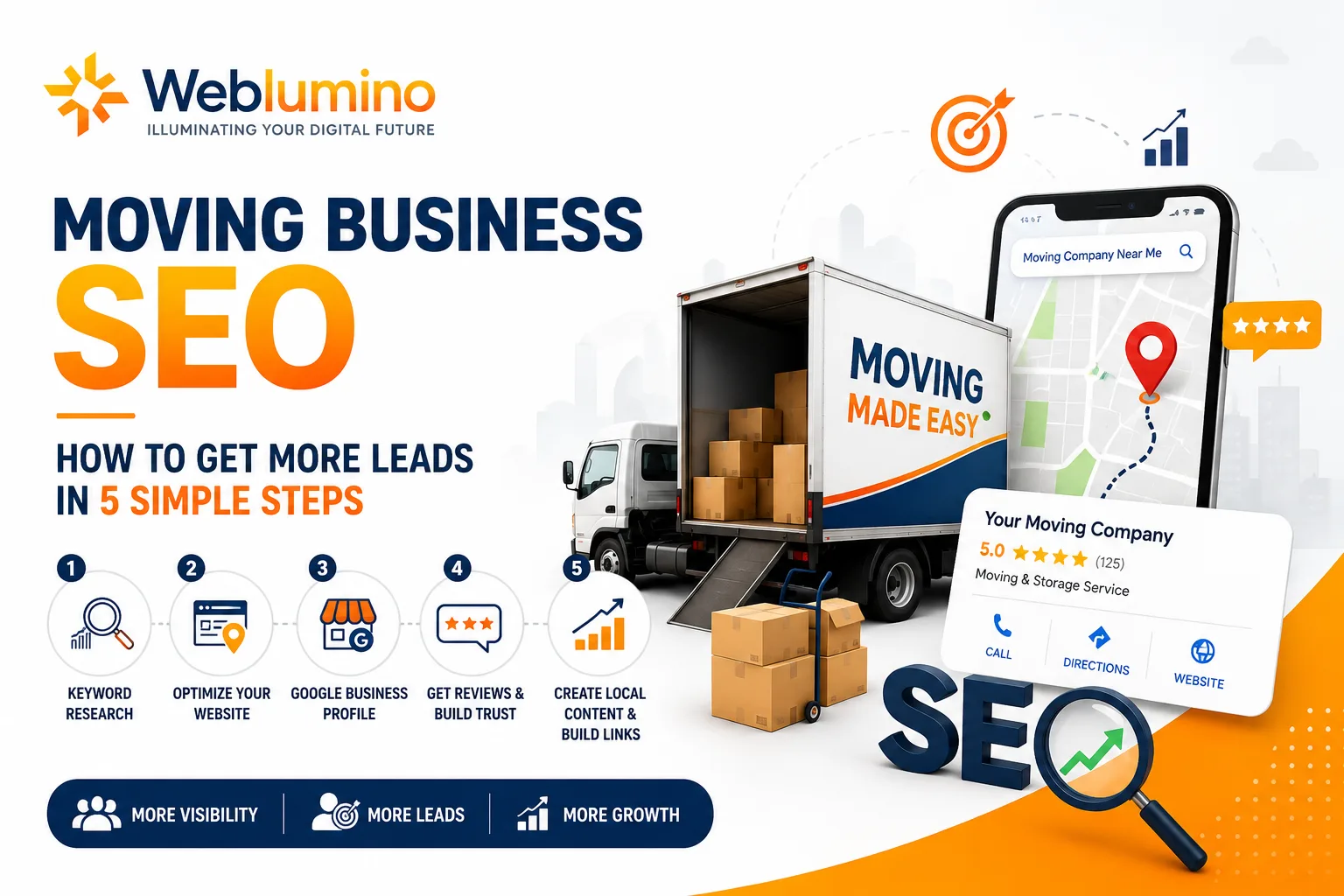
This is the advantage of Moving Business SEO. With proper Search Engine Optimization, you put your company in front of people in your area who are looking for a mover at the exact moment they need one. If you do it right, you are putting in the work for consistent, high-intent leads 24/7 and not having to pay for every click. Weblumino LLP has put together this guide to show you how. We lay out 5 straightforward yet effective steps for upping your website traffic and beating out the competition on Google, all part of a sound digital marketing strategy for movers that builds you a reliable pipeline of leads.
Step 1: Optimize Your Google Business Profile for Local Visibility
Put in a search for “movers near me” or “local moving company [city]” and what comes up first isn’t some website, it’s Google Maps and the Local Pack. So if your Google Business Profile is anything less than fully optimized, you might as well be invisible when it matters most.
How to fully optimize your Google Business Profile for movers:
- Claim and verify your listing at Google Business Profile Manager
- Fill in every field: business name, address, phone, website, service areas, and hours
- Choose the right primary category: “Moving and Storage Service” or “Moving Company.”
- Add high-quality photos of your trucks, crew, and completed moves
- Write a keyword-rich business description that mentions your service area and key offerings
- Post regular Google updates — promotions, tips, or seasonal offers
Then there is the matter of consistency. Your Name, Address, and Phone number have to be an exact match on your site, your GBP, and every online directory you are on. You can’t afford to be lax about it; even the slightest difference will do damage to your local SEO.
Step 2: Target the Right Keywords with Local SEO Intent
As for keyword research, it underpins any good SEO plan for a moving business. The point isn’t just to draw in visitors but to put yourself in front of the ones with the intent to hire. You need to be after those high-intent, local keywords.
High-value keyword categories for movers:
- Service + location: “residential movers in [city],” “office movers [city].”
- Long-tail intent: “How much does it cost to hire movers in [city]?”
- Problem-solving: “affordable moving company near me,” “same day movers [city].”
- Comparison: “best moving companies in [city],” “licensed movers vs. unlicensed.”
Put some of the free resources at your disposal to work for you. Whether it is Google’s Keyword Planner, Ubersuggest, or even the “People Also Ask” feature on a Google search, they will tell you what your target customers are putting in the box. Once you have those terms, assign them to the appropriate pages on your site; there is no point in cramming every keyword onto a single page.
Here is a pro tip: if you want to put down roots in a particular city or neighborhood, build a service area page for it. You will see much better local search rankings with something like “Movers in [Suburb Name]” than you would from a run-of-the-mill homepage.
Step 3: Build a Fast, Mobile-Optimized Website That Converts
After all, there is no use in herding traffic to a website that is slow and hard to navigate, you might as well be sending leads into a cul-de-sac. When it comes to optimizing a mover’s site, keywords are only part of the story.
Essential website elements for moving company SEO:
- Page speed: Google penalizes slow sites. Aim for under 3 seconds load time using tools like PageSpeed Insights
- Mobile-first design: Over 70% of moving service searches happen on mobile. Your site must look and function flawlessly on all screen sizes
- Clear CTAs: Place prominent “Get a Free Quote” or “Book Now” buttons above the fold on every key page
- Click-to-call: Your phone number must be tappable on mobile, so potential customers can call in one tap
- Trust signals: Display licenses, insurance details, years in business, and association memberships prominently
- Structured data (Schema markup): Help Google understand your business type, location, reviews, and services for richer search results
When it comes to on-page SEO for a moving company, the service pages are where you make your mark. Make sure everyone has their own title tag and meta description, an H1 heading that incorporates your target keyword, and at least 500 words of content that is both original and of use to the reader.
Step 4: Earn Reviews and Build Local Authority
Then there are online reviews. They are perhaps the most potent tool in your marketing arsenal, yet many moving companies don’t make enough of them. Google’s algorithm will look at the quality and quantity of your reviews to determine how to rank you locally, but what matters more is that a prospect is likely to read them before he or she picks up the phone.
How to build a strong review profile:
- Send a follow-up text or email after every completed move, asking for a Google review
- Make it easy — include a direct link to your GBP review page
- Respond to every review — positive and negative — professionally and promptly
- Never buy fake reviews — Google detects and penalizes this
- Expand to Yelp, Angi, HomeAdvisor, and Facebook for multi-platform credibility
You can further your local SEO authority with citations from the likes of Yelp, Yellow Pages, and Bing Places, as well as any niche directories for the moving trade. The more consistent your citation is, the better your NAP signal and local search standing will be.
Don’t forget to go after backlinks from local sources too – whether that is a city directory, a feature in the local paper, a blog post, or a tie-up with a real estate agent or storage facility. After all, good backlinks are still among the top three things Google looks at for rankings.
Step 5: Create Content That Drives Traffic and Generates Leads
If you want to put your moving company on the map online and do more than just have a few service pages, you need content marketing. Put up a blog or some kind of resource section, and you will be in a position to rank for hundreds of other keywords, win over potential customers with trust, and make your brand the authority in the area.
High-performing content ideas for moving companies:
- “Moving Checklist: Everything You Need to Do Before Moving Day”
- “How Much Does It Cost to Hire Movers in [City]? [Year] Pricing Guide”
- “5 Questions to Ask Before Hiring a Moving Company”
- “Local Moving vs. Long-Distance Moving: What’s the Difference?”
- Neighborhood-specific guides: “Best Neighborhoods to Move to in [City].”
The way to go about it is to write a post that zeroes in on one keyword and gives an answer to the sort of questions your customers are actually asking. Make sure to put an internal link in there pointing back to your quote or main service page. It is an effective means of marketing your business without having to part with any cash for advertising.
Be consistent and put out two or four pieces of content a month. You will see the value in the long run; the articles you put together months down the line will still be ranking and turning in leads. In the end, that is what makes SEO so much more powerful than paid ads.
Moving Company SEO Checklist: Quick Reference
Use this moving company SEO checklist to audit your current standing:
- Google Business Profile is fully completed and verified
- NAP is consistent across all directories and the website
- Website loads in under 3 seconds on mobile
- Dedicated service area pages created for each city served
- Each page has a unique title tag, meta description, and H1
- Active review generation process in place
- Citations submitted to top 20+ local directories
- Blog publishing at least 2x per month
- Google Analytics and Search Console are connected
- At least 5 high-quality backlinks from local/relevant sources
Why SEO Outperforms Paid Ads for Long-Term Moving Company Growth
There is a simple truth about paid advertising: the second you put down your wallet, it ceases to be of any use. With SEO for movers, you are in a different position altogether; it puts equity into your business. Over time, all those blog posts and backlinks, every review and optimized page, add up to put you in front of more eyes for less money.
You will find that organic results draw far more clicks than the paid variety, which is no small thing for a service business where trust dictates the sale. A prospective customer who comes across your moving company in an organic search, with a solid profile and good reviews to boot, is going to have more faith in you than in some rival who has merely bought the top spot on the ad.
If you are looking to generate leads, local SEO is hands down the best return on investment. This holds for the small and mid-sized mover up against national brands with their deep pockets for ads. In the end, your community ties, local know-how, and genuine reviews are things a national operation can never put together.
Ready to Grow Your Moving Company with SEO?
Weblumino LLP is your go-to for SEO services that put real, hard numbers on the table for moving companies. We take care of all the details of your digital presence – from optimizing your site and managing your Google Business Profile to content marketing and local citations – so you are free to do what you do best and get people where they need to go.
Our approach is tailored to the moving industry with tried and true strategies. It doesn’t matter if you are an upstart trying to make a name for yourself online or a seasoned operation set to run the local market; we have the plan for it. Give us a call at Weblumino LLP for a no-cost SEO audit, and we will show you where you can grow the most.
Frequently Asked Questions (FAQs)
SEO for moving companies is the process of optimizing your website, Google Business Profile, and overall online presence so your business ranks higher in search results when potential customers search for moving services in your area. It involves keyword targeting, on-page optimization, local citations, link building, and content creation, all working together to generate moving leads organically.
The majority of people searching for movers start on Google. If your business doesn’t appear on the first page — ideally in the Local Pack — you’re missing out on a massive pool of high-intent leads. SEO builds long-term visibility that compounds over time, unlike paid ads that stop delivering the moment your budget runs out.
Local SEO focuses on appearing in geographically relevant searches exactly where your customers are. By optimizing your GBP, building local citations, creating service-area landing pages, and earning local backlinks, you dramatically increase your chances of appearing in Google’s Local Pack, which receives the lion’s share of clicks for local moving searches.
The most effective keywords combine a service type with a location modifier, for example, “[City] moving company,” “movers in [city],” “affordable residential movers [city],” or “how much do movers cost in [city].” Long-tail keywords typically have lower competition and higher conversion rates since they attract people further along in their decision-making process.
Most moving companies begin seeing meaningful improvements in rankings and traffic within 3 to 6 months of consistent effort. Highly competitive markets may take 6 to 12 months for significant results. However, the rankings and authority you build through SEO are durable, unlike paid ads, they don’t disappear when you stop spending. The earlier you start, the greater your competitive advantage.
Google Maps rankings are driven by three factors: relevance (how well your GBP matches the search query), distance (proximity to the searcher), and prominence (how well-known your business is online). To improve all three: fully complete your GBP, define your service areas, actively collect Google reviews, maintain consistent NAP citations, and ensure your website links to your GBP.
Absolutely. Google uses reviews as a significant local ranking signal. More reviews, especially recent, detailed ones, signal to Google that your business is active, trusted, and relevant. Reviews also directly influence consumer decisions: most people trust online reviews as much as personal recommendations. A steady stream of genuine 5-star reviews can meaningfully boost both your rankings and conversion rate.
The most common mistakes include: having an incomplete or unverified Google Business Profile, inconsistent NAP information across directories, neglecting mobile optimization and page speed, targeting overly broad keywords instead of local ones, failing to generate or respond to reviews, publishing thin or duplicate content, and not tracking performance with Google Analytics and Search Console.
Yes, it’s arguably the single most important local SEO asset a moving company has. Your GBP powers your appearance in Google Maps and the Local Pack, which sits above all other organic results for location-based searches. A fully optimized GBP with accurate information, strong photos, regular posts, and healthy reviews can drive a significant portion of your inbound leads without any additional paid spend.
Yes, and for most moving companies, SEO delivers a higher ROI over the long term. While paid ads generate immediate results, they require ongoing budget and typically produce more expensive leads. SEO, once established, generates leads continuously at a fraction of the ongoing cost. Organic results also tend to produce leads with stronger intent. The most effective strategy uses SEO as the foundation while supplementing with paid ads during peak seasons.