
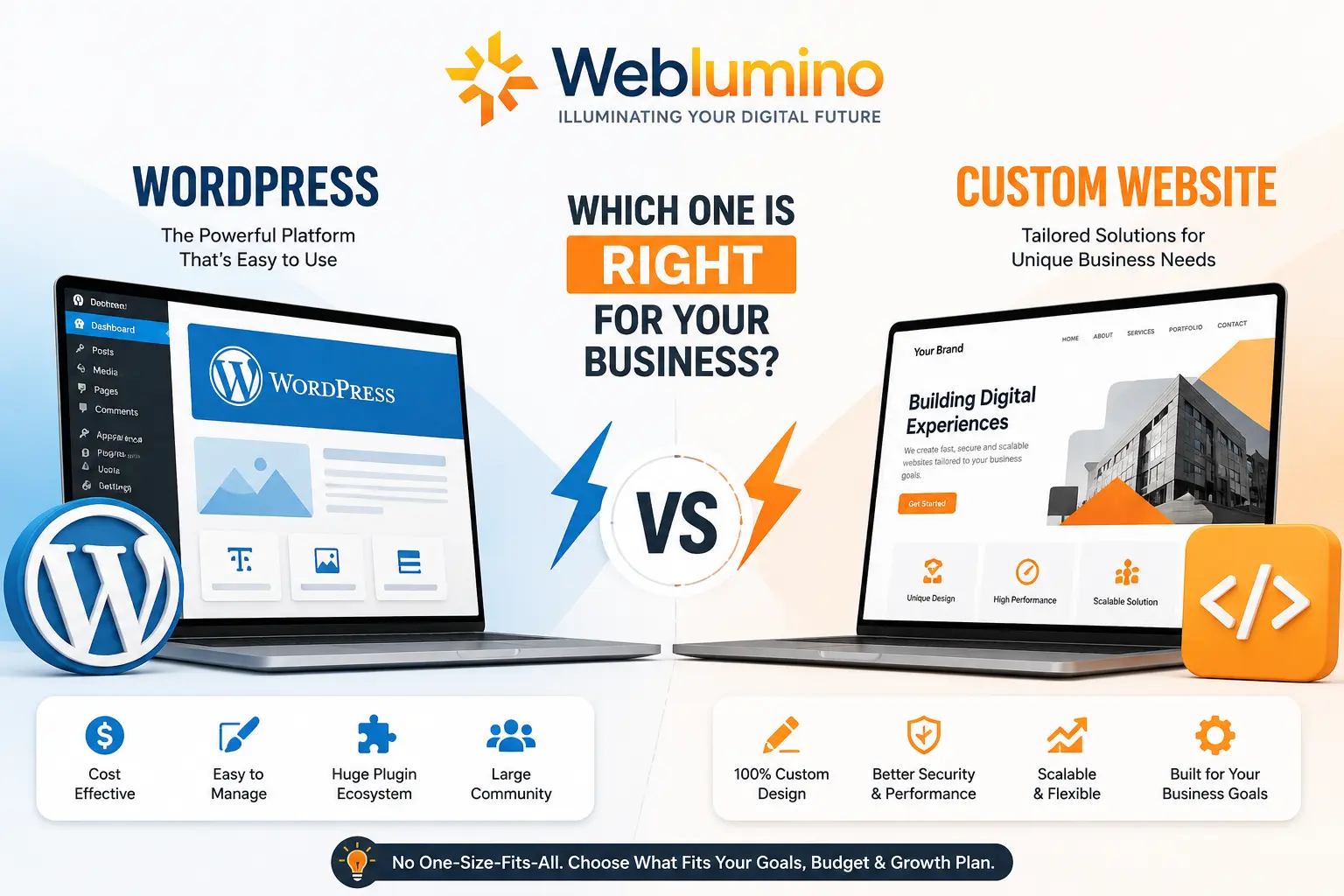
One of the most important choices you will wrestle with for your business’s digital home is the choice between WordPress vs a custom website. Both techniques can deliver incredible results, but they serve different needs, budgets, and growth strategies. This guide explains the real differences, letting you make an informed choice.
What Is WordPress?
WordPress, which is a content management system (CMS) that powers nearly 40 percent of the sites on the internet. It enables business owners to have a functional website up and running in no time with pre-built themes and plugins without writing a line of code.
Best suited for:
- Small to medium businesses
- Blogs, portfolios, and service websites
- Businesses with limited budgets
- Quick-to-launch projects
What Is a Custom Website?
Custom Website — an end-to-end solution, forming frameworks and code based on the direct needs of your business. No need for third-party themes or plugins, every feature his made just for your needs
Best suited for:
- Businesses with custom workflows or complex features
- High-traffic ecommerce platforms
- Business with complex integrations (CRMs, ERPs, custom APIs)
- In fact, the best brands are designed for scalability and performance.
WordPress vs Custom Website: Side-by-Side Comparison
| Factor | WordPress | Custom Website |
| Initial Cost | Lower (themes/plugins often affordable) | Higher (development from scratch) |
| Development Time | Days to weeks | Weeks to months |
| Flexibility | Limited by theme/plugin capabilities | Unlimited, built to spec |
| Maintenance | Regular updates for plugins, themes, and core | Maintenance scoped to your codebase |
| Scalability | Can struggle under heavy customization | Built to scale from day one |
| SEO Control | Good with plugins like Yoast/RankMath | Full control over technical SEO |
| Security | Vulnerable if plugins/themes aren’t updated | Security built around your specific stack |
| Design Uniqueness | Theme-based, may look similar to others | Fully unique, brand-specific |
| Ongoing Costs | Hosting, premium plugins, updates | Hosting plus developer support |
WordPress: Pros and Cons
Advantages
- Cost-effective: More affordable to start since less initial investment is needed, making it accessible for very small businesses and startups.
- Rapid deployment: cut down on time to go live with pre-built themes and page builders
- Mammoth Ecosystem of Plugins: Thousands of plugins are available to cover e-commerce, SEO, forms, and more.
- Simple content management: Nontechnical teams can easily update pages, blogs, and media.
- Strong community support: Well-documented tutorials and forums.
Drawbacks
Custom Website: Pros and Cons
- Plugin dependency: Plugins slow the site down and often conflict with each other.
- Security concerns: Outdated plugins and themes are generally the point of ingress for attacks.
- Performance drawbacks: Resource-intensive themes and a large number of code links can affect the site speed in a bad manner.
- Limits to customization: If the details of functionality are far too detailed, then they will require a custom plugin anyway, and this limits the cost-benefit further.
Advantages
- Purposefully built for your business: From features, workflows, to integrations, everything is tailor-made.
- Enhanced performance: Fewer unnecessary bloat means faster load times due to clean code.
- Less dependence on 3rd party resources means fewer places for security holes.
- Scalability: Built with the ability to grow with bigger traffic, new features, and complexity without a major rebuild.
- Only Branding: You can design your site however you want with zero theme limitations, so it looks and functions exactly as you want.
Drawbacks
- More expensive: Need more time and budget to develop from scratch.
- By definition, custom builds require more time to plan, design, and develop
- Persistent developer dependency: Usually involves developer efforts for updates and modifications since these are not just admin edits.
Key Factors to Consider Before Deciding
1. Budget
WordPress, on the other hand, is much simpler to install, and you can have a functional site up much faster if you’re looking to save money. Custom development minimizes long-term capital expenditure by offering superior performance and scale, but it is much more expensive when first developed.
2. Business Goals and Growth Plans
For a small business website highlighting services, WordPress may never be outgrown. However, if you’re developing an application that you expect will grow significantly, for instance, dealing with a lot of users or traffic, pricing high-complex user accounts, or customized integrations, it’s better to build a custom website now and avoid paying for costly migrations later.
3. Website Speed and Performance
Website speed significantly impacts user experience, conversions, and can even have a positive impact on SEO rankings. WordPress sites can be adequately fast simply by using caching, image compression, and lightweight themes, but custom websites have an advantage purely because there is no extraneous code to trim away.
4. SEO Requirements
Both these platforms allow strong SEO practices. WordPress plugins like Yoast or RankMath make the on-page SEO smooth for non-developer-oriented users. Custom websites provide the flexibility to tailor all technical SEO elements (like schema markup, site architecture, and core web vitals excellent for partnering with in-house SEO.
5. E-commerce Needs
WooCommerce passenger cars and WordPress do the job for small to mid-sized banks all the time, but in terms of e-commerce, we are talking mainly about trivial product catalogs. Custom development is commonly used for complex inventory systems, bespoke checkout flows, or platform-based high-volume transactions (Shopify Plus, Magento, or fully bespoke solutions), as every company works differently.
6. Mobile-Friendliness and User Experience
A responsive, mobile-friendly design is necessary because most web traffic is generated via mobile devices these days. Mobile Support: More or less from the beginning, WordPress themes are mobile responsive; on the other hand, custom websites can make pixel-perfect user experiences for mobile through journeys defined in advance.
7. Maintenance and Long-Term Support
WordPress itself consists of several individual components, like core, themes, and plugins, that must be updated regularly to maintain system security and functionality. Custom websites have a maintenance cost, but you are limited by your own codebase, not dozens of dependencies within 3rd party products.
Which One Should You Choose?
Choose WordPress if:
- You’re a startup or small business with a limited budget
- You need a website to live quickly
- Your requirements are standard (blog, portfolio, basic ecommerce, service pages)
- Your team needs to manage content without developer support
Choose a Custom Website if:
- You have specific functionality that off-the-shelf solutions can’t handle
- You’re planning for significant growth or scale
- Performance and security are top priorities
- You want a unique design with no theme constraints
Current Industry Trends (2025-2026)
- The increase in the use of Headless CMS: We are mainly using WordPress as a headless CMS with custom frontends (React, Next. JavaScript classes (jsc) to take advantage of the content management power of WordPress, combined with custom performance and design flexibility.
- AI-powered development: Speeding up build times and reducing costs, both for WordPress (via AI plugins) and custom-made sites ( via AI coding tools).
- Core Web Vitals matter a lot: More importance to page experience metrics by Google is driving many businesses towards performant custom builds or highly optimized WordPress setups.
- Hybrid Routes: Most companies start with WordPress for cost-effectiveness, but go for a custom solution after scaling, which should be planned from the first day itself.
Tips for Making the Right Choice
- Audit your must-have features first, then check if WordPress plugins can realistically deliver them without excessive customization.
- Think 3-5 years ahead, not just your launch needs — migration later can be more expensive than building custom now.
- Test page speed benchmarks for both options using tools like Google PageSpeed Insights before committing.
- Get a professional development consultation — an experienced team like Weblumino LLP can assess your specific requirements and recommend the most cost-effective, scalable solution.
- Don’t choose based on cost alone — factor in maintenance, scalability, and total cost of ownership over several years.
Frequently Asked Questions
Yes. WordPress is one of the most popular choices for small businesses due to its affordability, ease of use, and wide range of themes and plugins suited for service-based, retail, and portfolio websites.
Generally, yes. Custom websites have fewer third-party dependencies, reducing common vulnerability points. WordPress can be made secure, but it requires consistent updates and careful plugin management.
WordPress websites typically cost less upfront since they use existing themes and plugins. Custom websites involve development from scratch, so costs are higher but reflect tailored functionality and long-term scalability.
Yes, many businesses start on WordPress and migrate to custom solutions as they scale. Planning your content structure and data with future migration in mind makes this transition smoother.
Both can rank well. WordPress offers SEO plugins for easier optimization, while custom websites give full control over technical SEO elements like site speed, schema, and architecture.
Yes, through WooCommerce, WordPress supports e-commerce for small to mid-sized stores. For complex, high-volume online stores, a custom e-commerce solution may offer better performance and scalability.
Extremely important. With the majority of web traffic coming from mobile devices, a mobile-friendly, responsive design directly affects user experience, bounce rates, and search rankings.
Yes, typically. WordPress sites can launch in days to weeks, while custom websites require weeks to months, depending on complexity, due to the development-from-scratch process.
Final Thoughts
Best of all, there is no one bespoke response to the debate about WordPress vs custom sites. Your budget and timeline, specific needs from the software, and your growth plan will define what is best for you. WordPress. So, for a business with Common needs, WordPress is fast and cost-efficient, but for businesses having unique or complex examples, custom development provides flexibility, performance, and scalability.
However, if you are confused about narrowing down your business on which path can fit in, Weblumino LLP will help you evaluate your goals and design a website strategy, WordPress, custom, or hybrid that supports your growth for at least the next few years.