
Every era has a name, and this one, we proudly call the Digital Era. Each day, the world introduces new technology, smarter software, and powerful AI. that make our lives easier than ever. Need information? You’re just one click away. That single click connects you to the world. grows your business, and opens doors once thought impossible. But here’s a question worth asking: what about people living with disabilities? How do they experience this digital world? Are these advancements truly accessible to everyone? Are some people still being left behind? If you want to know the real answer, keep reading. This blog is for you.
First Things First – What Is NDIS?
NDIS stands for the National Disability Insurance Scheme. It is a very important program run by the Australian government. that provides financial support and services to help people with disabilities. This scheme includes those who are permanently and significantly disabled. In simple language, if you understand, those people suffering from their disability.
The Australian government directly said, “I will help you.” Under this program, every disabled person has the right to choose support services based on their needs. whether it’s therapy, daily care, community participation, or other services. This marks a significant change from before, when the government decided which services to provide to disabled people. Now, disabled individuals can make their own choices about their lives, including which services they want.
Under the NDIS, service providers are called NDIS Registered Providers. They are organizations and individuals registered with the government who offer quality services to participants. In the digital age, having a strong and professional website is very important for providers. When participants and their families look for a provider, their first impression comes from the website because they assess the provider based on it.
What are the NDIS requirements for Websites?
Every NDIS has requirements for websites to be accessible to all users, including those who are deaf, blind, or have any disabilities. The Australian government made a law called the Disability Discrimination Act 1992, which ensures that disabled people do not face difficulties when using a website. Currently, the NDIS supports more than 646,000 participants.
These requirements often align with the Web Content Accessibility Guidelines (WCAG) 2.1/2.2 Level AA, which guide how to make websites user-friendly for everyone, such as having a screen reader for blind users, captions for deaf users, and navigation options for people who cannot use a mouse and rely on keyboard controls. The website clearly explains what services are offered, participants’ rights, how to file complaints, and how data is kept secure.
All information is presented in simple and plain language, free of complicated words, and nothing to hide. After implementing these features, we tested the website with real users, and everything worked smoothly. Some participants speak Hindi and Auslan, so support for these languages is also available. A good NDIS website is one that everyone can easily use.
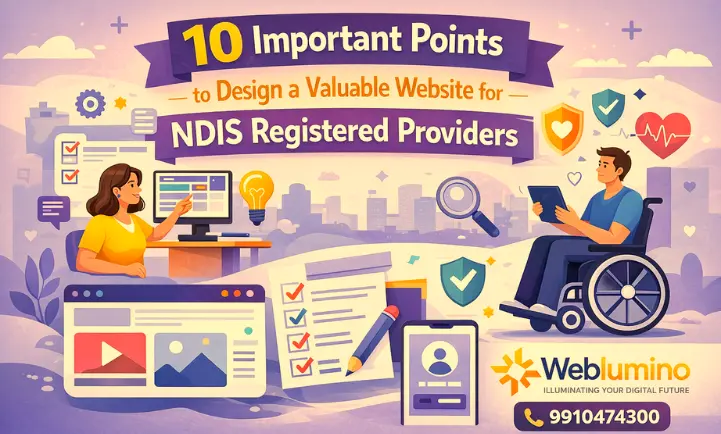
10 Important Points Every NDIS Provider Should Have
1. Clear NDIS Services Information
Use simple and clear sentences that are easy to understand in the NDIS plan. Instead of writing “We provide Core Supports and Capacity Building Supports,” say it like this: “We also help you build skills so you can live more independently.” When a mom reads her son’s plan and sees “therapeutic supports,” she may not understand what that means. But when your website says speech therapy, occupational therapy, and behavior support, she immediately knows you offer what her son needs and will call you.
2. Service area map
Every family has the first question: Are you available in our area? For this question, you should be well prepared. Keep a simple Google map or a list of suburb websites so they don’t need to email you.
3. Use Proper Forms
Only the name and email form are not working. You also need to ask for the NDIS number, types of plans, support categories, goals, and the option to upload the plan.
4. Make It Accessible
Screen reader support for blind users. Toggle button Keyboard navigation for those who cannot use a mouse. Good color contrast—follow WCAG 2 AA standards.
5. Be Pricing Transparent
You directly state how much the charges are. It helps the family immediately decide whether they can afford your fees or not.
6. Team Profiles That Build Trust
Families are choosing who will support them. They want to know who you are. Use real photos of your actual team. Stock photos undermine trust. Include real qualifications and experience. Add personal touches where appropriate. These details help families connect with your team.
7. Secure Payment Gateway
Many participants are self-managed, or their plan managers make payments online.
- Include a direct claiming option on the NDIS portal.
- Ensure invoicing and receipts are automatically generated.
- Having an SSL certificate and encryption on the website is essential to keep payments secure.
- Integrate with your practice management software — so participants can book, pay, and access records all from one place.
8. Resource Library
Navigating NDIS can be complicated. Your website will help. Keep downloadable resources—NDIS terminology guide, plan review checklist, support session tips. Organize resources by topic. Simple one-page PDFs work best.
9. Booking System
“Email us to book” creates unnecessary back-and-forth: you suggest times. They’re not available. They counter with alternatives, and three days pass before you finally find a time that works.
A booking system shows your availability upfront. Allowing participants to choose a time that suits them, while confirmation happens automatically. This doesn’t need to be complicated. Simple calendar integration with time slots works perfectly fine. For providers with many team members, this becomes even more valuable. Families can check if therapists are available. book an appointment with their preferred choice.
10. Mobile-Friendly Design
More than 60% of people use mobile devices to access websites. If your site does not look good on a phone, you could be losing more than half of your potential visitors!
- Ensure your website automatically adjusts to smaller screens.
- Text should be readable, buttons easy to tap, and forms frustration-free.
- Test on real phones and tablets — don’t just check on a laptop.
- Page load speed should be fast — slow websites make people leave
immediately.
Ready to Build a Website That Actually Works?
If your current website lacks these features. You’re making it harder than necessary for families to find and choose you. At Weblumino LLP, we’ve been creating NDIS provider websites that truly deliver results. We understand which features generate referrals, enhance accessibility, and streamline your daily operations. We provide everything your NDIS business needs. This includes accessible service pages and referral forms for NDIS inquiries. We create profiles for teams that help build trust. We offer secure payments, resource libraries, and effective booking systems.
At Weblumino LLP, we don’t just create websites; we truly understand the NDIS world. Understanding family needs and plan managers helps your business thrive. With better websites? Get in touch with Weblumino today! We’ll prove how our features can help your NDIS business grow. You’ll see how to increase referrals, build trust, and attract more participants.