
Search has changed. Users no longer scroll through ten blue links, they ask questions and receive synthesized, confident answers from AI systems like Google AI Overviews, Perplexity, and ChatGPT. In this new landscape, the question for marketers and content strategists is no longer just “how do we rank?” It’s “how do we get cited?”
The answer lies in understanding the role of E-E-A-T in GEO and how well your content signals trust to machines. As Generative Engine Optimization reshapes search visibility, E-E-A-T has become the single most important framework for determining which content AI systems choose to cite, reference, and surface.
What Is E-E-A-T, and Why Does It Now Matter for GEO?
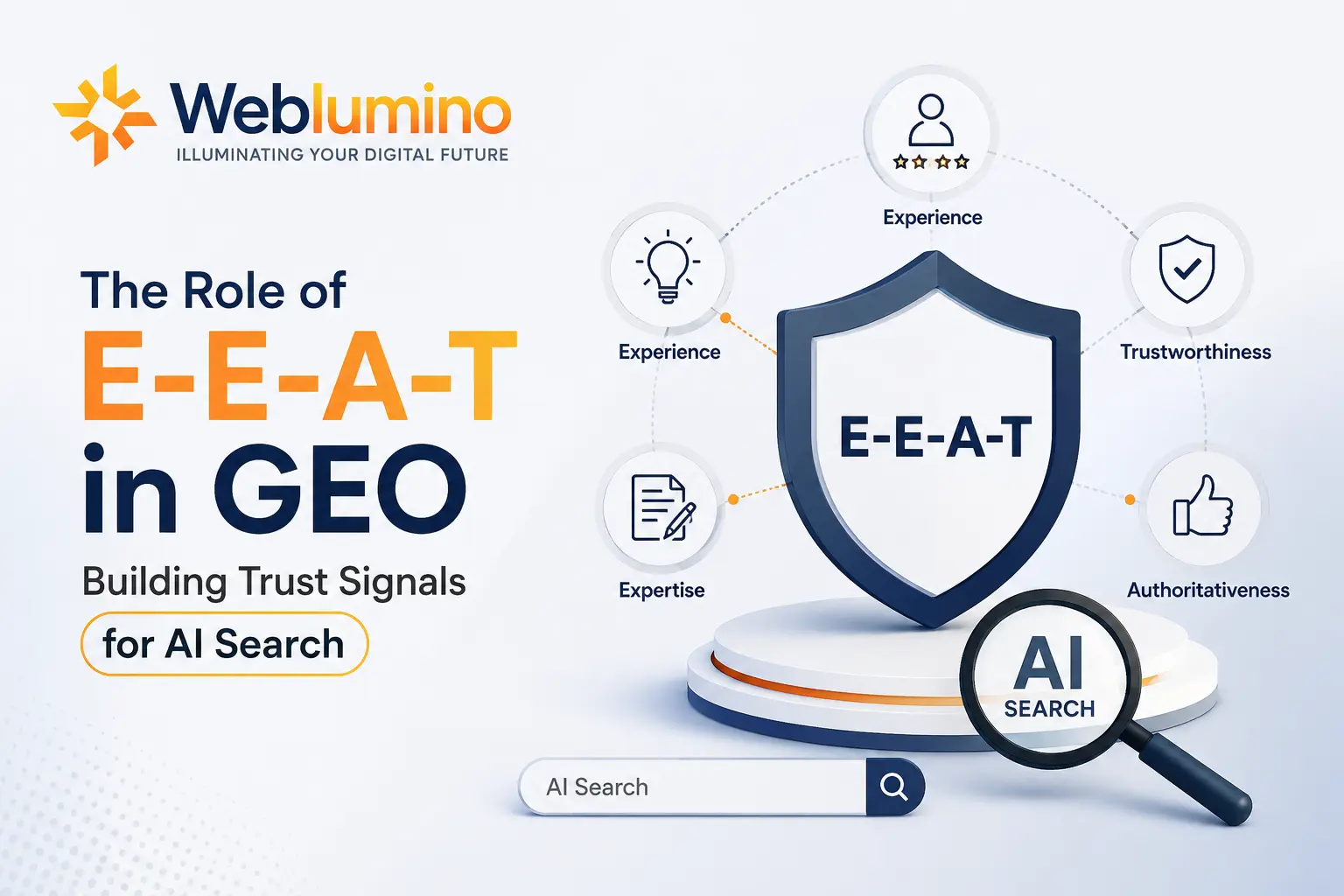
So let’s break down E-E-A-T: Experience, Expertise, Authoritativeness, and Trustworthiness. This framework from Google was introduced in its Search Quality Evaluator Guidelines to guide human raters in assessing the quality of a piece of content. In 2022, the original E-A-T model was updated to include “Experience”, responding to the trend that prioritizes lived knowledge (first-hand) over generic information.
Generative Engine Optimization (GEO) is the optimization of pieces that will be interpreted, attributed, and referenced by AI-led search engines in their generative responses. While traditional SEO worked to rank pages, GEO is working to be a verifiable source of the truth, the content that an AI uses as its input when it builds its answer.
The two are deeply connected. What used to be a standard for human evaluation, E-E-A-T, has evolved into a requirement that can be read by machines. AI without citation is useless because AI cannot confidently validate what it cannot cite. So, your E-E-A-T signals need to be overtly stated, laid out, and coded correctly; they cannot rely on good writing alone.
Breaking Down Each E-E-A-T Component for AI Search
1. Experience: Show That You’ve Been There
We train AI to recognise first-hand knowledge. Generic overviews, grounded in AI, fail to outperform content that showcases direct personal experience with a topic.
How to signal Experience for GEO:
- Include case studies, outcomes, and specific results from your own work
- Use first-person language where relevant (“In our campaigns, we found…”)
- Add dates and context to real-world examples vague anecdotes are discounted
- Include original data, screenshots, or documentation that can only come from direct involvement
- For product reviews or tutorials, show process steps that only practitioners would know
2. Expertise: Demonstrate Deep Domain Knowledge
Expertise goes beyond surface-level information. AI models are trained on vast datasets and can distinguish shallow, aggregated content from genuinely expert-level writing. Expertise must be demonstrated, not just claimed.
How to signal Expertise for GEO:
- Use precise, industry-specific terminology accurately (not for keyword-stuffing)
- Reference primary sources: research studies, official documentation, regulatory guidelines
- Create content at an appropriate depth, comprehensive enough to satisfy complex queries
- Implement Person schema markup on author profiles with credentials, publications, and affiliations
- Build dedicated, detailed author bio pages that AI crawlers can index and cross-reference
3. Authoritativeness: Get Recognized by Others
Authority is not self-declared it is earned through recognition. For AI systems, authority is measured by your entity’s presence and reputation across the broader web ecosystem.
How to signal Authoritativeness for GEO:
- Earn backlinks from established, topically relevant publications
- Get your brand, products, or experts mentioned in third-party editorial content (not just guest posts)
- Build a consistent entity presence: your brand name, key people, and core topics should appear consistently across Wikipedia, Wikidata, LinkedIn, Google Business Profile, and industry directories
- Publish original research that others cite. AI models weigh original data sources heavily
- Pursue podcast appearances, interviews, and co-authorship with recognized authorities in your niche
4. Trustworthiness: The Foundation Everything Else Rests On
Of the four E-E-A-T pillars, Trustworthiness is the most critical and the most technical. An AI system that cites inaccurate or deceptive content loses credibility with users. As a result, AI models apply extremely high scrutiny to trust signals before citing any source.
How to signal Trustworthiness for GEO:
- Ensure your site uses HTTPS and has no security warnings
- Display clear authorship, publication dates, and last-updated dates on every piece of content
- Implement structured data (Schema.org) for Article, Person, Organization, and FAQPage
- Maintain factual accuracy, outdated statistics, or corrected claims that aren’t updated are red flags
- Create a transparent About page, Contact page, and Privacy Policy
- Add citations and references to external authoritative sources within your content
- Use llms.txt files to provide AI crawlers with a structured overview of your site’s content and credibility signals
The GEO Shift: From Rankings to Citations
In traditional SEO, the goal was to appear at position one. In GEO, the goal is to be extracted and synthesized to have your content appear as a reference within an AI-generated answer, even when a user never visits your page.
This distinction changes content strategy in three fundamental ways:
1. Clarity over clickbait. AI systems parse meaning, not emotion. Headlines, subheadings, and paragraph structure should prioritize semantic clarity so that AI can extract and attribute specific claims accurately.
2. Structured data is non-negotiable. Schema markup is the language of machine-readable trust. Without it, even expert-level content may be overlooked by AI systems in favor of structurally cleaner competitors.
3. Entity consistency matters. Your brand name, author names, and topical focus should appear consistently across your website, social profiles, third-party mentions, and structured data. Inconsistency signals unreliability to AI models.
A Practical GEO-Focused E-E-A-T Audit Checklist
Use this checklist to evaluate your current content against GEO trust standards:
Content Layer
- Every article has a named author with a linked bio page
- Author bios include credentials, areas of expertise, and external profile links
- Content includes first-hand examples, data, or case studies
- External sources are cited with links to primary references
- Publication and last-updated dates are visible
Technical Layer
- The article schema is implemented with author, datePublished, and dateModified
- Person schema is implemented on author profile pages
- Organization schema is on the homepage with consistent NAP data
- The FAQPage schema is used where relevant
- llms.txt is configured to guide AI crawlers
Authority Layer
- Brand and key contributors have consistent profiles on LinkedIn, Google, and relevant directories
- Original research or data has been published and is referenced externally
- Third-party mentions and editorial links from relevant publications exist
Why YMYL Content Demands Stronger E-E-A-T Signals
Google’s concept of “Your Money or Your Life” (YMYL) content topics affecting health, finance, safety, and well-being carries the highest E-E-A-T burden. AI systems apply the same logic: the higher the potential impact of misinformation, the more rigorous the trust verification.
If your content touches legal, medical, financial, or safety topics, weak E-E-A-T signals are not just a missed opportunity, they are an active barrier to AI citation. Invest in credentialed authorship, medical or legal review notes, and primary source citations for any YMYL content.
E-E-A-T in GEO vs. Traditional SEO: Key Differences
| Factor | Traditional SEO | GEO (AI Search) |
| Primary goal | Rank on SERP | Get cited in AI responses |
| E-E-A-T evaluator | Human quality raters | Algorithmic + AI parsing |
| Trust signals | Backlinks, on-page SEO | Schema markup, entity consistency, citations |
| Content depth | Keyword coverage | Semantic comprehensiveness |
| Author importance | Optional | Critical |
| Structured data | Recommended | Essential |
FAQ: E-E-A-T in GEO and AI Search
Q: Is E-E-A-T an official Google ranking factor?
Google maintains that E-E-A-T is not a direct algorithmic ranking factor in the traditional sense, but it strongly influences the quality signals that do affect rankings and AI Overview inclusion. Think of it as the framework behind the factors, not a single lever you can pull.
Q: How is E-E-A-T evaluated differently in AI search vs. traditional search?
In traditional SEO, E-E-A-T was assessed by human quality raters using Google’s evaluator guidelines. In AI search, systems like Google’s AI Overviews and Perplexity evaluate trust programmatically through schema markup, entity recognition, consistency of information across the web, and citation patterns. You cannot rely on implicit signals; everything needs to be machine-readable.
Q: What is the single most impactful E-E-A-T improvement for GEO?
Trustworthiness specifically, implementing structured data and ensuring entity consistency. If AI systems cannot confidently identify who you are, what you know, and why others recognize you, they will not cite your content regardless of its quality.
Q: Does AI-generated content hurt E-E-A-T?
Not automatically, but AI-generated content that lacks first-hand experience signals, expert authorship, and original insight is consistently weaker on E-E-A-T dimensions. Human oversight, factual verification, and subject-matter expert review are essential when AI tools are part of the content production process.
Q: How do I build authoritativeness if my brand is new?
Focus on depth over breadth early on. Establish a clear topical focus, publish original data or analysis, pursue third-party editorial mentions in your niche, and ensure your authors have robust, verifiable profiles. Authority builds through consistent, credible output over time. There are no shortcuts, but narrow niche authority is achievable faster than broad domain authority.
Q: What role does schema markup play in E-E-A-T for GEO?
Schema markup translates your content’s trust signals into structured data that AI systems can parse. Key schemas include Article (for content metadata), Person (for author credentials), Organization (for brand identity), and FAQPage (for conversational query matching). Without a schema, AI systems must infer trust signals, and inference is less reliable than explicit declaration.
Q: How does E-E-A-T apply to local businesses optimizing for AI search?
Local businesses should ensure consistent NAP (Name, Address, Phone) data across all directories, maintain a verified Google Business Profile, and earn genuine customer reviews on multiple platforms. LocalBusiness schema and consistent entity information across the web directly influence whether AI systems surface your business in location-based AI queries
Q: What’s an llms. txt file, and should I have one?
An llms.txt file is a plaintext file placed in your site’s root directory that gives AI systems a structured summary of your site’s purpose, key topics, and authoritative content. It’s an emerging best practice for GEO similar to robots.txt for traditional crawlers, and helps AI models understand your entity and content hierarchy quickly.
Final Thought
The brands that will win in AI search are not the ones that stuff the most keywords or earn the most backlinks alone. They are the brands that make themselves easy for machines to trust. E-E-A-T in GEO is not a new checklist to follow, it is a fundamental shift in how credibility must be demonstrated.
At Weblumino LLP, we work with brands to build the technical and content foundations that AI systems recognize as authoritative. If your visibility in AI search is underperforming, the answer is almost always rooted in trust signals.
Start with your author infrastructure, implement structured data, and make your expertise machine-readable. The citations will follow.
About the Author
Weblumino LLP is a Delhi-based digital marketing and AI SEO agency helping brands build search visibility in the era of generative AI. From E-E-A-T audits to structured data implementation and GEO strategy, the team at Weblumino works with businesses to ensure their content is trusted, cited, and discoverable by both humans and AI systems.
Phone: 99104 74300 Address: Unit No-1082, 10th Floor, Aggarwal Millennium Tower-2, Netaji Subhash Place, Delhi – 110034