

The way we do search has evolved. If you are still gauging your site’s success by the old metrics of clicks and keyword rankings alone, you are not getting the full story.
Google made that point clear on June 3, 2026, when it put the finishing touches on its rollout of Search Generative AI Performance reports in Google Search Console. At the same time, they have introduced a new toggle so site owners can decide for themselves if their content is to be shown in AI search features or not.
You could call it the most consequential update to come out of Google Search Console in years. For any SEO, digital marketer, or content strategist, it is imperative to know what this means and how to put it to work.
What Is the Search Generative AI Performance Report?
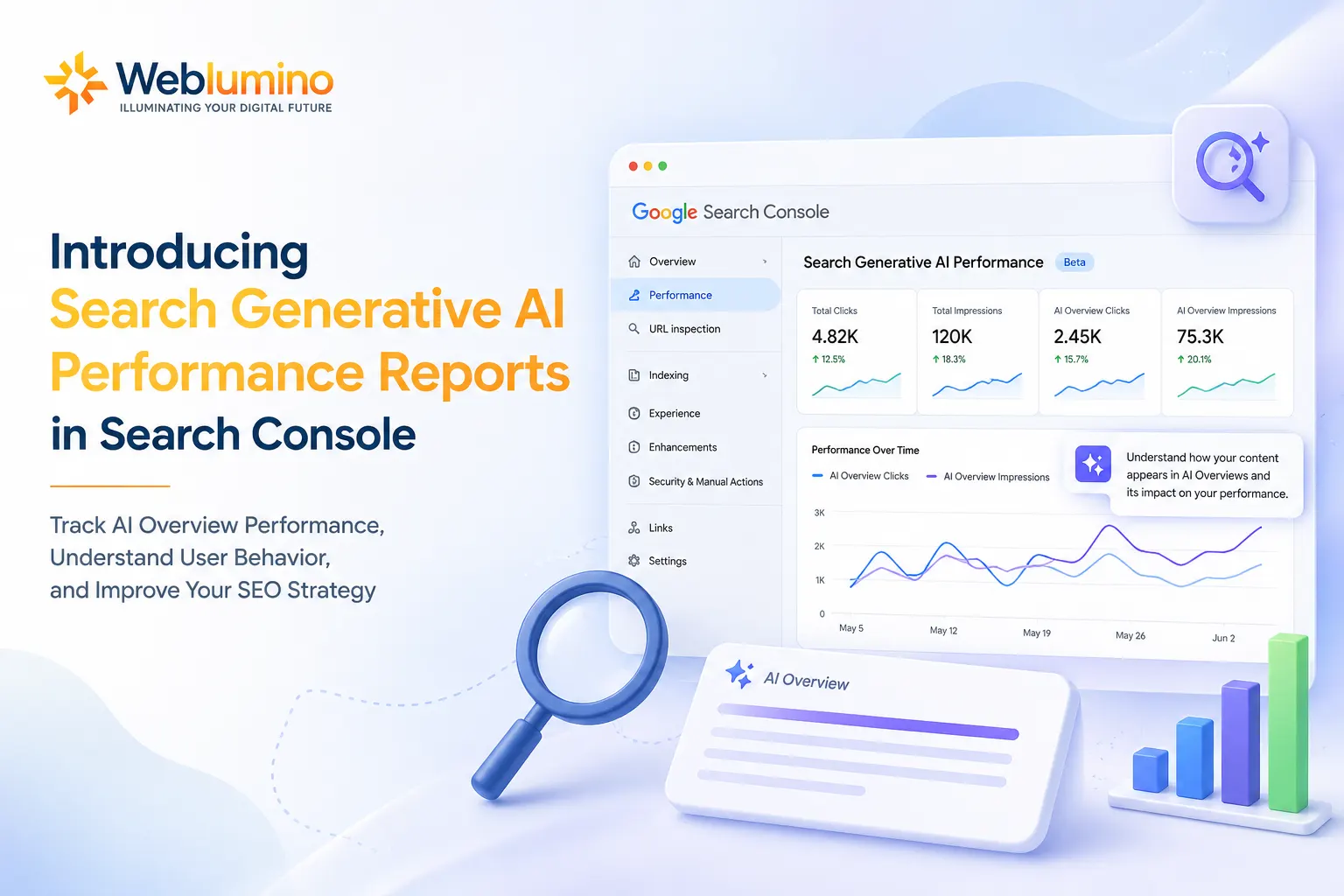
The new Search Generative AI Performance report is a dedicated section within Google Search Console that provides visibility into how your pages appear inside Google’s generative AI-powered search features, specifically AI Overviews, AI Mode, and AI Overviews in Discover.
Google is rolling out a new report to give website owners data on how their content and sites are performing within AI responses, AI Mode, and AI Overviews within Google Search.
Until now, SEOs had zero native data on AI Search performance. You could see that traffic from AI Overviews existed, but had no way to attribute it, analyze it by page, or benchmark it over time inside Search Console. That gap closes partially with this launch.
The report currently tracks the following metrics:
Impressions — how often URLs from your site appeared in generative AI features in Search and Discover. Pages — which specific URLs appeared within AI features. Countries — your visibility broken down by country. Devices — the device type users were on when your site appeared (available for Search results). Dates — performance over time with hourly, daily, weekly, and monthly granularity.
These five dimensions give you a working view of your presence in AI search, which pages are being cited, which markets you’re visible in, and how that visibility trends over time.
The Missing Metric: Click Data
Here’s the detail that will frustrate every performance marketer: there is no click data.
The reporting includes impressions, pages, countries, devices, and dates, but does not include click data. Google won’t be telling us how many searchers click from AI responses in Google Search to sites.
We are still in talks with website owners to see which insights will best serve their strategies and will be putting some new metrics in place as time goes on,” a Google spokesperson said when we put the question to them.
This is not surprising. Google has historically been protective of click-level data in Search Console, and AI responses complicate attribution further because users often consume answers directly without visiting the source. The absence of CTR data means you can benchmark AI impressions, but cannot yet calculate an AI-driven conversion funnel from within Search Console alone.
For now, the practical workaround is to combine Search Console’s AI impression data with Google Analytics 4 session-level data to observe whether traffic from organic search correlates with periods of high AI impression volume, a proxy, not a solution, but better than nothing.
The AI Blocking Toggle: Publisher Control, Finally
Alongside the performance report, Google is also testing an opt-out toggle a control within Search Console that lets site owners choose whether their content appears in AI search features.
Google said it is adding a “new toggle” within Google Search Console to allow sites to block their content from showing in AI search features such as AI Overviews, AI Mode, or AI Overviews in Discover. Google noted that “sites that opt out will not receive traffic or impressions from our generative AI features.”
Critically, this control will not be used as a ranking signal for search results outside of these generative AI Search features, so it should not negatively impact your site on core web search.
This is a meaningful assurance. Publishers who are concerned about content being summarized without driving traffic, a legitimate concern across media, education, and ecommerce, can opt out without worrying about ranking penalties in traditional organic search results.
The toggle arrives after considerable pressure. Google did promise these controls were coming after some backlash from the EU, and now they are starting to roll out. Early studies showed that one-third of SEOs indicated they would block Google from showing their content in AI search features.
Rollout Status: Who Has Access Right Now?
For now, you will only find the opt-out toggle and the AI Performance report if you are among a select group of site owners in the United Kingdom. The company is rolling out this new report to a few in the UK to start with, before making it available worldwide down the road.
Should you not have the report yet or be based outside the UK, do keep an eye on your Search Console dashboard in the weeks ahead. While Google has made it known that a global release is coming, they have not given us any firm dates for it.
It’s also worth noting the competitive context: Bing Webmaster Tools has already released its AI performance report. Neither Google’s nor Bing’s reports have click data, but at least Bing’s report is global, while Google’s report is currently a subset of UK site owners.
What This Means for Your SEO Strategy in 2026
The launch of Search Generative AI Performance reporting signals a fundamental shift in how we think about search visibility. Impressions in AI responses are now a measurable, trackable KPI, separate from traditional organic rankings and click-through rates.
Here’s what smart SEOs should do right now:
1. Establish your AI impression baseline. Once access rolls out to you, immediately pull your first 90-day AI impression report. This becomes your benchmark for every optimization effort that follows. Segment by page and country to understand where your content already has AI traction.
2. Identify your highest-impression pages and study them. Which pages are being surfaced in AI responses? What structure, format, and content depth do they share? Typically, pages that perform well in AI citations are authoritative, well-structured, and directly answer specific user questions — so model new content on those patterns.
3. Think about AI impressions as a new funnel stage. A user who sees your URL cited in an AI Overview may search your brand next, land directly later, or share the result. AI impressions may not drive direct clicks, but they build brand visibility and trust. Track whether periods of high AI impressions correlate with branded search volume increases in your Performance report.
4. Make a deliberate decision about the opt-out toggle. This isn’t a decision to rush. Before opting out, consider your business model. If your revenue depends on users arriving at your site (advertising, lead generation, or e-commerce), opt-out may protect traffic in the short term. If your goal is brand authority and you benefit from being cited as a trusted source, staying in AI features may serve your long-term SEO better. There is no universal right answer, it depends on your site’s monetization model and audience behavior.
5. Continue investing in technical SEO. The foundations of structured data, fast page speed, clear site architecture, and authoritative content are exactly what help Google’s AI systems identify and cite your pages. Technical SEO is no longer just about crawling and indexing, it’s the infrastructure that enables AI discoverability.
How to Optimize for Search Generative AI Performance
Appearing in AI responses is not a separate discipline from SEO — it’s an extension of it. But there are specific practices that increase your chances of being cited in AI Overviews and AI Mode:
Write to answer, not just to rank. AI Overviews are built to resolve user intent directly. Content that clearly states an answer in the first paragraph, then elaborates, is better suited for AI citation than keyword-dense long-form content that buries the point. Use direct language, clear headers (H2/H3), and short, declarative sentences for key points.
Use structured data wherever applicable. Schema markup for FAQs, How-Tos, Articles, and Products signals semantic meaning to Google’s AI systems. This makes it easier for AI features to parse your content accurately and cite the right page for the right query.
Strengthen your E-E-A-T signals. Experience, Expertise, Authoritativeness, and Trustworthiness remain the standard that Google uses to evaluate content quality — and these signals influence AI citation behavior. Detailed author bios, cited sources, first-hand experience, and external editorial mentions all contribute.
Keep content factually accurate and regularly updated. AI systems favor pages with verifiable, current information. Stale or inaccurate content not only risks being surfaced incorrectly but may be deprioritized as AI systems become better at evaluating factual reliability.
FAQ: Search Generative AI Performance in Google Search Console
What exactly is the Search Generative AI Performance report in Google Search Console?
It’s a new reporting section that shows how often your website pages appear within Google’s AI-powered search features, specifically AI Overviews, AI Mode, and AI Overviews in Discover. It provides impression data broken down by page, country, device, and date.
Does the report show how many people clicked on my site from AI Overviews?
No. Click data is not included in the current version of the report. Google has indicated it will introduce additional metrics over time, but there’s no confirmed timeline for when click data will be added.
Who can access the Search Generative AI Performance report right now?
As of June 2026, it is rolling out to a subset of website owners based in the UK. Google plans to expand access globally, but no specific date has been announced.
What is the AI content blocking toggle and should I use it?
The toggle is a control within Search Console that lets you opt your site out of appearing in AI Overviews, AI Mode, and related generative AI features. If you opt out, you will not receive impressions or traffic from these features. However, opting out does not affect your rankings in standard organic search results. Whether to use it depends on your site’s goals and monetization model.
Will opting out of AI features hurt my standard organic SEO rankings?
According to Google, no. The opt-out toggle is specifically for generative AI features and will not be used as a ranking signal for core web search results.
How is this different from the regular Search Performance report?
The standard Search Performance report covers organic web search clicks, impressions, CTR, and position for traditional blue-link results. The new AI Performance report specifically tracks visibility within AI-generated responses, an entirely different placement and user experience.
How can I improve my AI Overviews impressions?
Focus on content that directly answers user questions, implement structured data, build E-E-A-T signals, maintain factual accuracy, and ensure your technical SEO fundamentals (crawlability, page speed, structured data) are solid. Pages that clearly demonstrate topical authority and are well-structured tend to perform better in AI responses.
Is Bing offering a similar report?
Yes, Bing Webmaster Tools already has an AI performance report, and it’s currently available globally, giving it broader reach than Google’s initial UK rollout. Neither report includes click data at this time.
What should I do if I don’t have access yet?
Monitor your Search Console notifications and the Search Console interface for the new report section. In the meantime, document your current organic search performance as a baseline, so you can measure change once AI impression data becomes available to you.
How does this change how I should report SEO performance to clients or stakeholders?
It adds a new visibility dimension. Where previously you reported clicks, rankings, and impressions from organic search, you can now (once access expands) also report AI feature impressions. This shifts the conversation from pure traffic delivery to brand presence across the full search experience, which is increasingly relevant as AI responses become a primary touchpoint before clicks occur.
Final Thoughts
The launch of Search Generative AI Performance reports in Google Search Console is a milestone moment for the SEO industry. For the first time, site owners have a native tool to measure how AI-powered search features engage with their content — and for the first time, they have a formal opt-out mechanism.
This doesn’t mean traditional SEO is less important. If anything, the principles that make content rank well — authority, accuracy, clarity, technical health , are the same principles that make it citation-worthy in AI responses. The measurement layer has just expanded.
At Weblumino LLP, we believe adapting to this change early gives businesses a competitive advantage. Establishing your AI impression baseline now, understanding which pages are already performing in AI search, and making an informed decision about the opt-out toggle are the immediate priorities. The brands that treat AI search performance as a core KPI alongside traditional organic metrics will be the ones with the clearest strategic edge as this technology continues to mature.
Want expert guidance on navigating AI Search and Google SEO in 2026? Get in touch with the team at Weblumino LLP.